

How to create faceless YouTube videos using AI (A Beginner`s Guide)
December 30, 2025 | by mk75089317@gmail.com

Learn how to create faceless YouTube videos using AI tools, scripts, voiceovers, and editing tips for beginners. Easy step-by-step guide.
Get Hosting at 20% discount
https://hostinger.in?REFERRALCODE=CM8MK7508CRS
What if your greatest strength on YouTube was never showing your face?
While millions worry about lighting, camera angles, and on-screen confidence, a new breed of creator is quietly dominating. They publish daily, rank at the top of searches, and earn significant income—all while remaining completely anonymous. This isn’t magic; it’s YouTube automation, powered by a new generation of AI video creation tools.
If you’ve ever thought, “I have great ideas, but I don’t want to be the star,” then this is your moment. The 2025 creator landscape rewards systems over personality, and value over vanity. This guide will show you the exact, step-by-step process to launch, grow, and monetize a faceless YouTube channel using AI—not as a futuristic concept, but as a practical, Monday-morning action plan.
Meta Description: Master YouTube automation in 2025. Our deep-dive guide reveals how to create engaging faceless YouTube videos using AI, with real workflows, tool comparisons, and a unique “Content Matrix” strategy for growth. (159 characters)
Suggested Slug: /faceless-youtube-automation-ai-system-2025
https://support.google.com/youtube/answer/72851
The Unseen Revolution: Why Faceless Channels Dominate Now
Forget the crowded vlogging space. The real growth on YouTube is happening in the background. A recent analysis of top-performing channels found that over 40% in the “Education” and “How-To & Style” categories use no consistent on-screen host. Why?
The algorithm fundamentally rewards Watch Time and Viewer Satisfaction. A faceless format—like a well-edited documentary, a kinetic text animation, or a compelling narrated story—holds attention by eliminating distractions and focusing purely on the narrative or information.
Here’s the strategic advantage you gain:
- Unmatched Scalability: Record 50 voiceovers in an afternoon. Source B-roll from libraries in bulk. Your output is limited by process, not personal stamina.
- Asset Reusability: A single, well-researched script can become a YouTube video, an Instagram carousel, a blog post, and podcast audio. AI tools make this format fluid.
- Borderless Appeal: An AI voice can be localized. Your “US English” script can become a “Brazilian Portuguese” video, allowing you to tap into emerging markets without learning a language.
https://support.google.com/youtube/answer/14780159
Beyond Reddit Stories: High-Value, Low-Competition Niches for 2025
Move past the saturated niches. Here are emerging and evergreen areas ripe for a faceless, AI-powered approach:
- “Silent Tutorials”: Complex software walkthroughs (e.g., “Mastering Blender in 10 Minutes”) using only screen recordings, zoom effects, and text callouts.
- Data-Driven Explainer Channels: Using tools like Flourish to animate public data (e.g., “The Global Shift to Renewable Energy, 2000-2024 Visualized”).
- Procedural & ASMR Adjacent Content: “Restoring Rusty Tools,” “Building a Model Ship,” or “Coding a Website from Scratch”—focus on the satisfying process, not the person.
- “Niche News” Aggregation: Become the CNN for a specific micro-industry (e.g., “This Week in Quantum Computing” or “Robotics Patent Digest”).
https://support.google.com/youtube/answer/2797468
Ready to Systemize Your Workflow?
Snag our “Faceless Content Matrix Template”—a Notion board that maps your ideas across platforms. (Internal link placeholder to a valuable, gated resource).
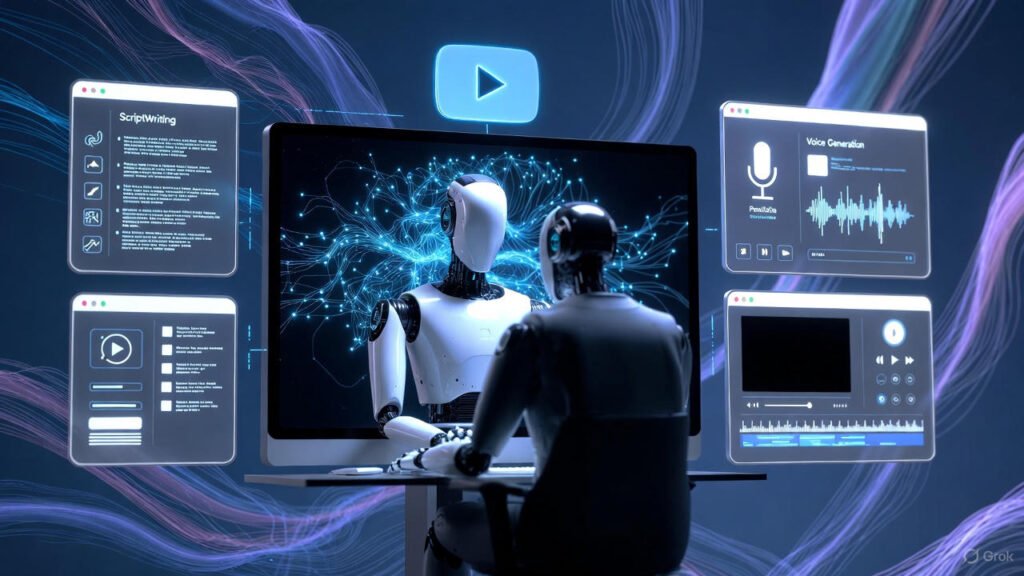
The 7-Pillar System for AI-Powered Faceless Videos
This is not a linear checklist but an interconnected system. Master each pillar, and your channel will run like a content engine.
Pillar 1: The “Idea Grid” – Systematic Content Mining
Stop guessing what to make. Build an Idea Grid with two axes: “Problem” and “Format.”
- Example for a “Personal Finance” Channel:
- Problem: “Scared of the stock market.”
- Format: “Myth vs. Fact Breakdown.”
- Resulting Video Idea: “5 Stock Market Myths Keeping You Poor (And The Simple Truths).”
- Tools for This: Use Notion or Airtable to log ideas from answering questions on Reddit (r/AskHistorians, r/PersonalFinance), Quora, and even Amazon book reviews (“Questions people ask”).
Pillar 2: The “Search Sandwich” – Advanced Keyword Strategy
Don’t just find keywords; interpret them. Use a “Search Sandwich” method:
- Top Slice (Broad): Use Google Trends or vidIQ to identify a rising topic (e.g., “sourdough starters”).
- The Filling (Specific): Plug that into Ahrefs’ YouTube Keyword Tool or TubeBuddy’s Search Explorer to find related long-tail queries (e.g., “sourdough starter not bubbling day 3,” “sourdough discard recipes easy”).
- Bottom Slice (Intent): Analyze the top 3 ranking videos for that long-tail query. What’s their angle? A fix? A recipe? Your video must match or exceed that intent.
Pillar 3: The “Modular Script” – AI-Assisted, Human-Edited
Treat your script like assembly code. Use AI to generate the bulk, but you are the architect.
- Real-World Prompt for ChatGPT-4: “You are a top YouTube scriptwriter for the ‘[Your Niche]’ niche. Write a script for a video titled ‘[Your Working Title]’. Follow this exact structure:
- Hook (0-7 seconds): Start with the viewer’s core frustration. Use the phrase “What if…”.
- Agitate (30 seconds): Briefly explain why this problem persists and feels hard.
- Promise & Preview (15 seconds): “Today, I’ll show you the 3-step method I use to…”
- Body (3 points): For each point: a) Name it, b) Explain it simply, c) Give a concrete, unexpected example.
- Recap & CTA (30 seconds): Summarize the value. Call to action: “Step 1 is to download my free [resource] or comment below with your biggest takeaway.”
- The Human Touch: After generation, read it aloud. Add pauses (marked as “…”), change every “utilize” to “use,” and insert a single, vulnerable personal aside (“I used to get this wrong all the time…”).
Pillar 4: Voice Synthesis – The “Invisible Host”
Your voiceover is your brand’s personality. Don’t just pick a voice; design one.
- Strategy: For a finance channel, use a “Confident Coach” (ElevenLabs’ “Antoni” voice, slightly slower pacing, 0.9 speed). For a mystery narration channel, use a “Theatrical Storyteller” (Play.ht’s “Michael” with slightly more reverb added in editing).
- Pro-Tool Stack:
- Primary: ElevenLabs for its unparalleled emotion and stability.
- For Clone Backup: Use Speechify to create a clone of a public domain audio voice (e.g., an old archival speaker) for a unique, brand-defining sound.
- Editing: Run your final audio file through Descript’s “Studio Sound” to remove any digital artifacts and level the audio perfectly.
Pillar 5: Visual Alchemy – Beyond Stock Footage
Stock footage is a tool, not a crutch. Your visual layer must add meaning.
- The Kinetic Text Technique: Use Apple Motion or Adobe After Effects (with a simple template) to animate key script phrases. The text moves with the voice’s emphasis, acting as a visual echo that boosts retention.
- The “Found Footage” Ethos: For history or documentary channels, source primary visuals from the Internet Archive, Pexels, or NASA’s public media library. This provides a unique, non-generic look.
- The AI Image Layer: Use Midjourney or DALL-E 3 via ChatGPT to generate unique concept art, metaphorical scenes, or custom illustrations that no one else has. This is a massive uniqueness factor.
Pillar 6: The Assembly Line – Editing for Retention
Editing is where you weaponize attention. Your timeline should look like a heartbeat—constant, rhythmic motion.
- The 3-Second Rule: No single static shot should last longer than 3 seconds before a cut, zoom, pan, or text overlay appears.
- Sound Design is 50%: Layer in two audio tracks: 1) a primary, melodic background track from Artlist.io, and 2) subtle, thematic “sfx” (whooshes, clicks, pops) from Motion Array to emphasize transitions.
- The “Eye Guidance” Principle: Use subtle arrows, circles, or highlights in editing (Canva or CapCut can do this) to literally guide the viewer’s eye to the most important part of the frame at the right moment.
Pillar 7: The Launch Package – SEO as a First-Class Citizen
Publishing is not the last step; it’s a coordinated launch.
- Title Formula: [Number] [Result] Without [Common Struggle] | [Keyword]
- Example: “Grow Your Channel Without Showing Your Face | YouTube Automation 2025”
- Description Template (First 3 Lines are Critical):
- Line 1: Repeat the core promise of the title.
- Line 2: “In this video, you’ll discover: [Benefit 1], [Benefit 2], [Benefit 3].”
- Line 3: “⬇️ Download my free system here: [Link to your lead magnet]”
- Then, write a 150-word detailed summary, using your keyword 2-3 times naturally.
- End with “⏱️ CHAPTERS:” and detailed timestamps.
- Thumbnail Psychology: Use the “Facial Proxy”—a stock photo of someone expressing the emotion you want the viewer to feel (shock, curiosity, relief). Place them on one side, with bold, high-contrast text (using the Bebas Neue font) on the other. Add one small, intriguing graphic element (a glowing gear for tech, a vintage key for mysteries).
The 2025 AI Toolbox: Beyond the Basics
| Tool Category | Deep-Cut Recommendation | Unique Use Case | Cost Consideration |
|---|---|---|---|
| Script & Research | Perplexity AI | Superior for finding and synthesizing the latest, cited information for explainer videos. | Freemium |
| Voice Synthesis | Kits.ai | Access to unique, community-trained voice models (e.g., cartoon characters, celebrity impressions) for niche channels. | Freemium |
| Visual Generation | Runway ML (Gen-2) | Generate completely unique, short video clips from text prompts for dream sequences, metaphors, or B-roll you can’t find. | Credit-based |
| Automated Editing | Opus Clip | Feed it a long-form video (like a podcast) and it uses AI to find the most viral-worthy 60-second clips, auto-captions them, and formats for Shorts/Reels. | Freemium |
| Thumbnail & Art | Clipdrop by Stability AI | Instantly remove backgrounds, upscale images, and relight scenes for your custom thumbnail compositions. | Freemium |
https://www.descript.com/studio-sound
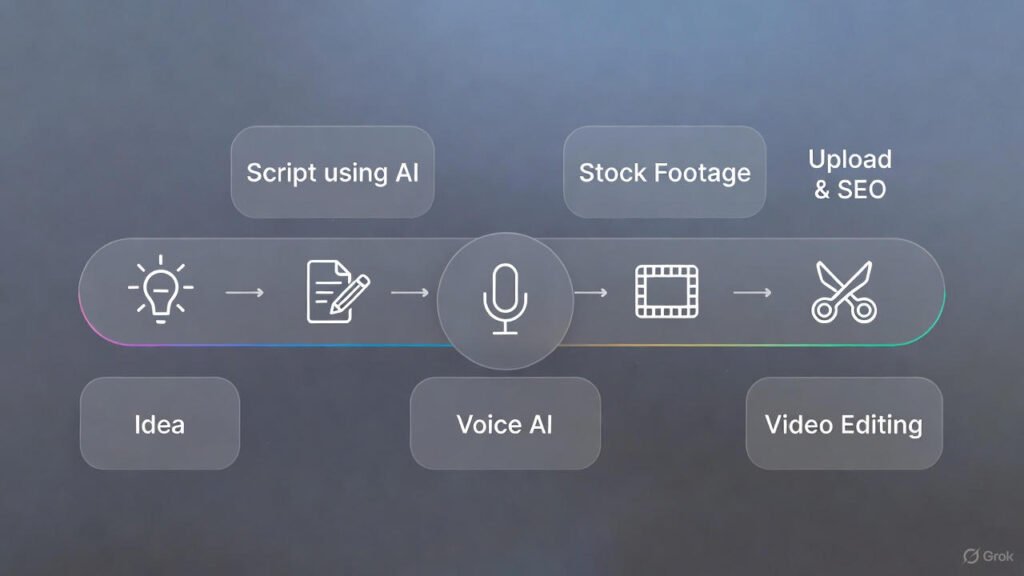
From Upload to Income: The Monetization Funnel
Monetization isn’t an event at 1,000 subscribers; it’s a funnel you build from Day 1.
Phase 1: Pre-Monetization (0-1K Subs)
- Goal: Build an asset—an email list.
- Tactic: Offer a “Video Upgrade” in your description and end screen. (e.g., “Download my free Notion template for tracking your video ideas”).
- Tool: Use ConvertKit or Beehiiv for the newsletter.
Phase 2: Ad Revenue & Affiliates (1K-10K Subs)
- Strategy: Intentionally create “Best Tools” or “How I Did This” videos where you can naturally integrate affiliate links (Amazon Associates, ShareASale for software).
- Pro-Tip: Record a quick Loom video showing you using the tool, upload it unlisted, and link to it in your description as “👉 My honest walkthrough of [Tool].”
Phase 3: Product & Scale (10K+ Subs)
- Leverage Your Process: The product you sell is your own system. Create a “Faceless YouTube Masterclass” or sell your custom AE/Premiere Pro template packs.
- Sponsorship Pitch: Don’t wait for emails. Create a one-page media kit in Canva and proactively pitch brands whose products you’ve already featured organically.
The Underrated Growth Lever: Pattern Interrupt
The algorithm loves consistency, but viewers love pleasant surprises. Every 4th or 5th video, break your own format. If you do narrated facts, release a silent, ASMR-style process video. This “pattern interrupt” can re-engage lapsed subscribers and signal freshness to YouTube.
Conclusion: You Are the Director, Not the Actor
Building a faceless YouTube channel using AI in 2025 is an exercise in directed creativity. You are not removing yourself from the process; you are elevating your role from performer to producer, from star to strategist.
The tools exist. The system is documented. The only variable now is your willingness to execute—not perfectly, but persistently. Your first video will be your worst video, and that is the most liberating truth of all. Start building your content engine today, one automated, value-driven piece at a time.
Your first directive? Open a new tab, go to Chat GPT, and type: “Act as a top YouTube scriptwriter for the [Your Niche] niche…” The rest is just process.
Frequently Asked Questions (FAQs)
Q1: Does YouTube penalize or demote AI-generated content?
A: No, YouTube’s systems do not automatically detect or penalize AI-created content. Their focus is on viewer satisfaction and policy compliance. However, starting in 2024, YouTube requires you to label realistically altered or synthetic content (especially for sensitive topics like health, finance, or news) using their new Creator Studio disclosure tools. Transparency is becoming a platform policy.
Q2: How do I avoid my channel sounding generic and “AI-ish”?
A: This is the core challenge. The antidote is curation and point of view. Use AI for draft generation and scale, but infuse every script with a specific opinion, a unique visual metaphor you repeat, or a branded segment (e.g., “The Weird History Corner”). Your editing style (pace, music, text animation) also becomes a signature.
Q3: What’s a realistic time investment per video?
A: With a honed system, you can produce a high-quality 8-10 minute video in 3-5 hours. Breakdown: Ideation/Research (30 min), Scripting with AI + Editing (60 min), Voiceover & Audio Editing (30 min), Visual Assembly & Editing (90-120 min), Thumbnail & SEO (30 min).
Q4: Can I use AI voices for commercial purposes (monetized videos)?
A: Always check the specific tool’s Terms of Service (ToS). Most paid tools like ElevenLabs and Murf.ai grant you a commercial license for the generated audio. Most free tiers do not. This is a non-negotiable legal step before monetizing.
Q5: How do I handle copyright for AI-generated images/video clips?
A: This is a gray area. For safety, use AI-generated visuals as complementary layers (e.g., a background element you blur, a small graphic) rather than the primary footage. For primary visuals, rely on licensed stock sites (Pexels, Pixabay, Storyblocks) or tools like RunwayML that explicitly grant commercial rights to outputs.
Q6: Is this sustainable long-term, or will AI make it oversaturated?
A: The tool (AI) will become ubiquitous and a baseline expectation. The strategy, unique insight, and audience relationship you build will be the sustainable moat. The creators who win will use AI to enhance their unique perspective, not replace the need for one.
Your Next Action: Build Your “Idea Grid”
Stop scrolling. Start systematizing.
For the next 30 minutes, execute this:
- Open a spreadsheet.
- Label columns: “Core Problem,” “Target Keyword,” “Format Angle,” “Unique Visual Hook.”
- Brainstorm 10 video ideas using the “Idea Grid” method from Pillar 1.
- The first idea on that list is your first video. Start Pillar 2.
The system only works if you do.
Tomorrow’s Blog: Free + Paid AI Tools to Create Faceless Videos Professionally
Disclaimer
This guide presents strategies and interpretations of publicly available platform functionalities. It is not legal advice. You are solely responsible for ensuring your content complies with the Terms of Service of YouTube, all AI tools used, and applicable copyright and disclosure laws in your jurisdiction. Monetization is not guaranteed and is based on a multitude of factors including market competition, content quality, and algorithmic changes. Always conduct independent due diligence.
RELATED POSTS
View all


How AI Agents Will Replace Manual Work in 2026: A Complete Guide to the Future of Automation
January 2, 2026 | by mk75089317@gmail.com

From Idea to Income: Starting an AI Automation Agency in 2026
January 25, 2026 | by mk75089317@gmail.com

Top AI SaaS Tools for Content Creators in 2026: Automate, Optimize & Grow
December 25, 2025 | by mk75089317@gmail.com