

How AI Agents Will Replace Manual Work in 2026: A Complete Guide to the Future of Automation
January 2, 2026 | by mk75089317@gmail.com

AI Agents will automate repetitive work by 2026, replacing tasks—not humans. Learn AI automation skills to stay ahead.

Get Hostinger at 20% Discount
https://hostinger.in?REFERRALCODE=CM8MK7508CRS
How AI Agents Will Replace Manual Work in 2026: Your Guide to the Coming Automation Revolution
Introduction
Imagine a world where your workday starts not with a pile of emails, but with a comprehensive report prepared overnight by your digital employee. A colleague that doesn’t sleep, doesn’t take breaks, and handles repetitive tasks with flawless accuracy. This isn’t a scene from a sci-fi movie—this is the imminent reality of 2026, powered by AI Agents.
Are you a freelancer in Mumbai, a student in Delhi, a business owner in Texas, or an office worker in New York? If so, the rise of AI Agents replacing manual work in 2026 will directly impact your career, business, and income. This blog post is your essential guide to understanding this seismic shift.
But what exactly are AI Agents? Think of them as the next evolution of AI tools. While today’s ChatGPT or Midjourney requires your constant prompting, an AI Agent is an autonomous system that can be given a high-level goal—like “run this month’s social media campaign”—and it will independently plan, execute, and refine the tasks to achieve it. 2026 is poised to be the turning point where this technology moves from early adoption to mainstream implementation, fundamentally altering how we work across India, the USA, and the globe.
Let’s dive deep into this future, unpack what it means for you, and most importantly, how you can not just survive but thrive.
What Are AI Agents? (A Beginner-Friendly Explanation)
Let’s break down this potentially complex term into simple, digestible parts.
At its core, an AI Agent is an artificial intelligence program that can perceive its environment, make decisions, and take actions to achieve specific goals without constant human intervention. It’s not just a tool; it’s an automated worker.
Key Difference: AI Tools vs. AI Agents
- AI Tools (Today’s Standard): You command every step. Example: You use an AI writing tool. You must type the prompt, “Write a blog intro about SEO,” review the output, and then give another command, “Now write the first subheading.”
- AI Agents (The 2026 Future): You command the outcome. Example: You tell your AI Agent, “Manage the SEO for our new product page.” The Agent will autonomously: research keywords, analyze competitors, draft content, optimize meta tags, and even schedule it for publishing—updating you only upon completion or if it hits a roadblock.
In essence, AI tools are assistants you micromanage; AI Agents are employees you delegate to.
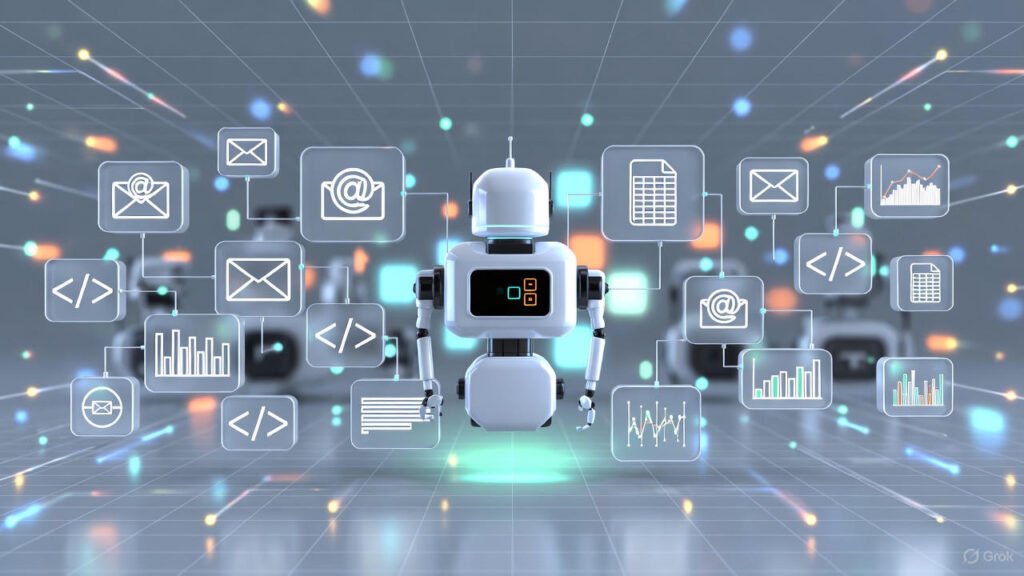
Why AI Agents Will Replace Manual Work in 2026: The Inevitable Shift
The move towards autonomous AI Agents isn’t just about cool tech; it’s driven by hard, undeniable business and economic logic. Here’s why 2026 is the year the scales tip decisively.
1. The Compelling Cost-Saving Proposition
For a business owner in Surat or a startup founder in San Francisco, payroll is the biggest expense. An AI Agent, once developed and integrated, operates at a fraction of the cost. It eliminates expenses related to salaries, benefits, office space, and equipment for the tasks it automates. The ROI on AI automation becomes too significant to ignore.
2. Unmatched Speed & Superhuman Accuracy
Humans get tired, distracted, or make errors in repetitive tasks. AI Agents don’t. They can process data, generate reports, and execute workflows in minutes—tasks that might take a team days. In data-heavy fields, their accuracy nears perfection, reducing costly mistakes in accounting, data analysis, and customer records.
3. The 24/7/365 Workforce
The global market never sleeps. While your team in Chennai logs off, an AI Agent can continue generating leads from the US market, providing customer support, or monitoring system performance. This round-the-clock operation is a massive competitive advantage.
4. Unlimited Business Scalability
Scaling a human team is slow and expensive (hiring, training, management). Scaling an AI Agent workforce can be as fast as upgrading a software license. Need to handle 10,000 customer inquiries instead of 1,000? An AI Agent system can be scaled almost instantly to meet demand.
Industries That Will Be Most Affected by AI Agents
No sector will remain untouched, but some will feel the transformation more immediately and deeply.
1. IT & Software Development
AI Agents will move beyond just writing code snippets. They will autonomously debug programs, write and run tests, manage deployment pipelines, and monitor system health. For developers in Bengaluru or Silicon Valley, the role will shift from writing every line of code to architecting systems and overseeing AI Agent teams.
2. Customer Support & Sales
The first line of customer interaction will be almost entirely AI-driven. AI Agents will handle queries, process returns, book appointments, and even conduct initial sales calls with natural, empathetic conversations. Human agents will step in only for complex, high-value, or escalated issues.
3. Marketing, Advertising & Content Creation
Imagine an AI Agent that doesn’t just write a single social media post, but plans the entire quarterly calendar, creates the graphics, writes tailored copy for each platform, schedules posts, and then analyzes performance to optimize the next cycle. This will be the norm for digital marketing in 2026.
4. Data Entry, Bookkeeping & Administrative Jobs
These highly repetitive, rule-based tasks are prime for full automation. AI Agents will extract data from invoices, reconcile transactions, update CRM records, and manage schedules without human oversight. This impact will be felt strongly in roles across corporate offices in both India and the USA.
5. Freelancing & Remote Work
The freelance marketplace on platforms like Upwork or Fiverr will transform. Basic graphic design, content writing, video editing, and SEO tasks will be commoditized by powerful, low-cost AI Agents. Freelancers will need to specialize in complex, strategic, or creative work that agents cannot yet replicate.
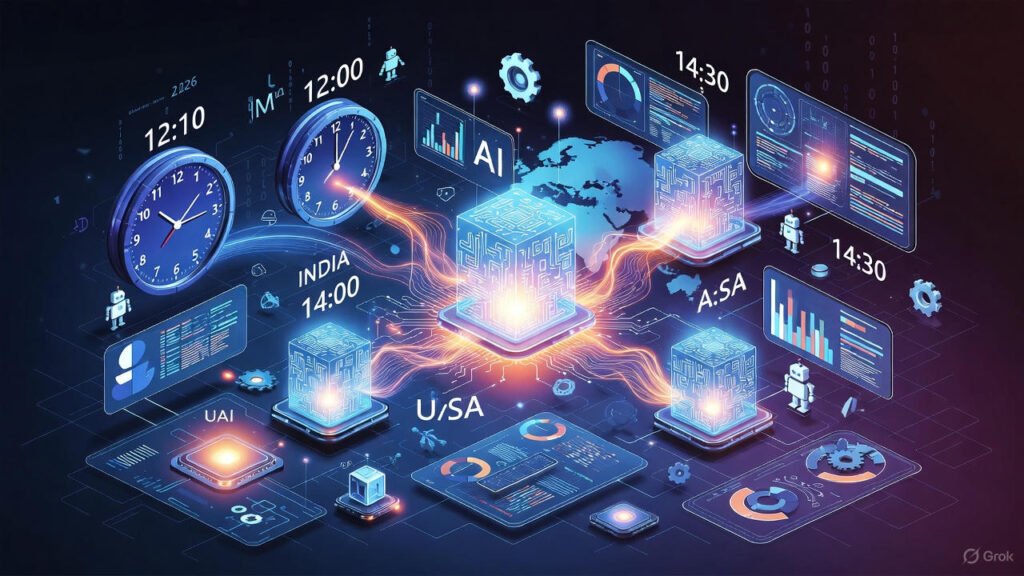
AI Agents Use Cases: Real-World Examples from India & the USA
Let’s make this practical with scenarios you can relate to.
- For a Small Business in India: A kirana store owner in Pune uses an AI Agent to manage inventory. The agent analyzes sales data, predicts future demand for atta or biscuits, automatically places orders with suppliers, and optimizes shelf layout plans—all while keeping costs minimal.
- For a US-Based Startup: A two-person startup in Austin uses an AI Agent as their entire “operations team.” It qualifies leads from the website, schedules demos in their calendars, onboard new customers via automated emails, and generates weekly performance dashboards.
- For Corporate Offices: At a large multinational, an AI Agent is assigned to each project manager. It automatically tracks project timelines, sends reminders to team members in different time zones (like between Hyderabad and New York), prepares status reports, and flags potential risks.
- For Online Earning: An individual earning online with AI in 2026 might run a fleet of niche websites. AI Agents research trending topics, generate and optimize all content, build backlinks through outreach, and manage ad revenue—requiring only high-level strategy input from the owner.
Jobs That Will Disappear vs. Jobs That Will Grow: A Clear Comparison
| Jobs Likely to Decline or Transform | New & Growing Job Opportunities |
|---|---|
| Data Entry Clerk | AI Agent Trainer & Supervisor |
| Basic Customer Support Representative | AI Ethicist & Compliance Manager |
| Routine Content Writer | AI-Powered Content Strategist |
| Bookkeeper (for routine tasks) | AI Systems Auditor & Analyst |
| Telemarketer | Complex Sales Negotiator (for high-value deals) |
| Basic Graphic Designer | Creative Director for AI Output |
New Opportunities on the Horizon:
The rise of AI Agents will create entirely new career paths:
- AI Agent Manager: Overseeing and coordinating multiple AI Agents within a business.
- Prompt Engineer & AI Whisperer: Specializing in crafting the precise instructions that guide AI Agents to optimal outcomes.
- Automation Integration Specialist: The tech professional who seamlessly blends AI Agents into existing company workflows.
- Human-AI Collaboration Facilitator: Focusing on change management and training teams to work effectively with AI colleagues.
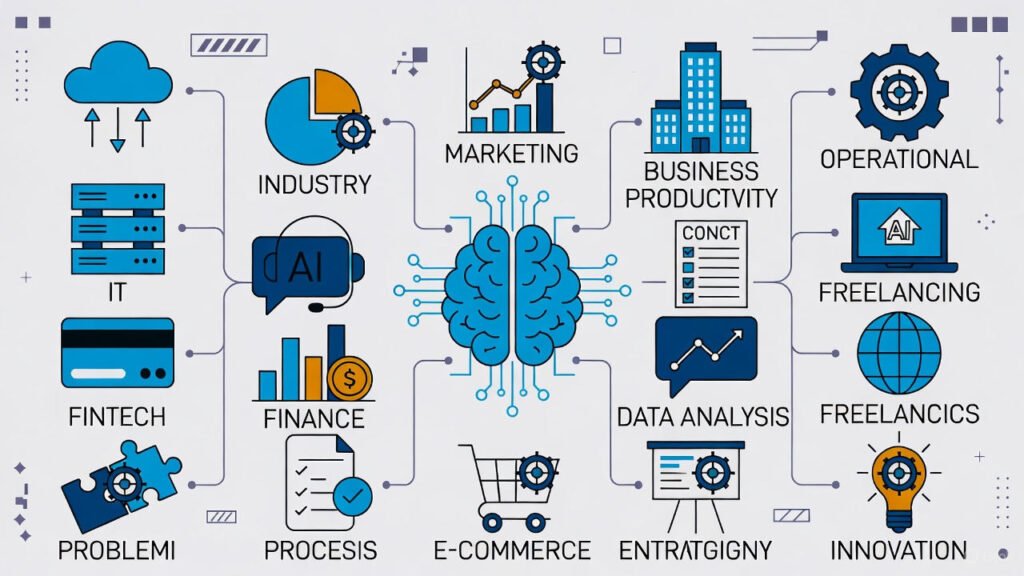
How Individuals Can Prepare for the AI Agent Era: Your Action Plan
The time to adapt is now. Here’s how you can future-proof your career.
Skills to Learn Before 2026:
- AI Literacy: Understand how AI works. Not as a coder, but as a user. Take free courses on platforms like Coursera or Google’s Digital Garage.
- Critical Thinking & Problem-Sraming: The #1 skill will be identifying problems and defining goals for AI Agents to solve.
- Creativity & Emotional Intelligence (EQ): Skills that AI cannot replicate. Focus on innovation, strategy, empathy, and human connection.
- Data Interpretation: Moving beyond data entry to data storytelling—understanding what the numbers mean for business decisions.
Master AI Automation Skills:
- Learn to use current AI tools (like ChatGPT Advanced, Claude, or Midjourney) to their full potential. This is the training ground for managing future Agents.
- Explore no-code automation platforms (Zapier, Make.com) to understand workflow automation logic.
Online Earning Ideas for the AI Era:
- Niche AI Consulting: Help local businesses in your city (e.g., Jaipur shops or Chicago cafes) identify and implement their first AI Agent solutions.
- AI-Augmented Creative Services: Offer “Premium Human+AI” content packages where your creative direction and editing polish AI-generated drafts.
- Selling AI Agent Prompts & Templates: Create and sell sophisticated prompt kits that help others achieve specific outcomes with AI Agents.
OpenAI Learning Hub (AI Guides)
Is AI a Threat or an Opportunity? A Reality Check
Let’s debunk some common myths.
Myth 1: “AI will take ALL jobs.”
Fact: AI will take many tasks, not necessarily all jobs. It will replace specific functions, forcing job roles to evolve, not always disappear.
Myth 2: “Only low-skilled jobs are at risk.”
Fact: White-collar, repetitive cognitive work (like basic analysis, reporting, drafting) is equally, if not more, vulnerable. Physical jobs in unpredictable environments (plumbing, nursing) are safer for now.
Myth 3: “AI is too expensive for small businesses.”
Fact: The cost is plummeting. By 2026, AI tools for business will be SaaS (Software-as-a-Service) products accessible via subscription, much like websites are today.
The Reality: AI is a tool. A hammer can build a house or break a window. The outcome depends on the wielder. For the proactive, it’s the greatest opportunity for productivity and wealth creation in history. For the passive, it poses a significant risk of obsolescence.
The Future of Work in 2026 & Beyond: AI + Human Collaboration
The future isn’t humans vs. machines; it’s humans with machines.
- The Hybrid Workforce: Teams will consist of humans and AI Agents working in tandem. The human provides vision, ethics, and creativity; the Agent provides scale, speed, and data-crunching.
- Impact on Salary & Productivity: While routine job salaries may stagnate, individuals who leverage AI to amplify their output will see their value and income soar. Overall economic productivity is set for a historic boost.
- The New Work Ethic: The premium will shift from “who works the longest hours” to “who can most effectively define problems and manage AI systems to solve them.”
Conclusion: Your Path Forward in an AI-Driven World
The countdown to 2026 has begun. The wave of AI Agents replacing manual work is not a distant speculation; it’s an approaching certainty. This transformation will reshape the future of work in India, the USA, and across the world.
The central question of this decade is no longer “Will AI change work?” but “How will I adapt?”
The choice is clear: you can be a bystander disrupted by this change, or you can be an architect building your future with it. The most valuable asset you have is time—time to learn, experiment, and position yourself at the forefront of this shift.
Start today. Pick one AI tool relevant to your field and master it. Explore one online earning with AI idea. Invest in learning how to think strategically and manage workflows. The AI automation revolution will create more wealth than any previous technological shift—but that wealth will flow to those who are prepared.
Ready to take control of your future in the AI age?
- Subscribe to our newsletter for weekly insights on AI trends and practical automation tips.
- Read more AI automation blogs on our site to deepen your knowledge.
- Learn AI skills now—explore our curated list of beginner-friendly courses and start your journey.
The future belongs to those who build it with the best tools available. In 2026, the best tool will be an AI Agent. Make sure you’re the one holding the leash.
Can Beginners Learn AI Automation?
Yes, beginners can easily learn AI automation.
You don’t need coding or a technical background—most AI automation tools are no-code and beginner-friendly. By starting with simple AI tools and small workflows, anyone can learn the basics in a few weeks and gradually move to advanced AI agents. This makes AI automation one of the best future-ready skills for beginners in 2025–2026.
next post: “How AI-Powered SaaS Tools Are Changing Small Businesses in 2026” (publish tomorrow)
RELATED POSTS
View all


AI Tools for Solopreneurs: Work Less, Earn More in 2026
January 4, 2026 | by mk75089317@gmail.com

The Ultimate Guide to AI Tools for Faceless Videos (Free & Paid)
December 31, 2025 | by mk75089317@gmail.com
Struggling with AI Output? Learn Prompt Engineering for Consistent Results
January 11, 2026 | by mk75089317@gmail.com