

How to Create & Sell AI-Generated Digital Products in 2026 (Beginner’s Guide)
January 20, 2026 | by mk75089317@gmail.com

Imagine creating a digital product in hours, not months, and selling it to a global audience 24/7. This is the power of AI automation in 2026. For beginners in India, the USA, and worldwide, AI-generated digital products have become the gateway to serious online earning and passive income. This guide is your actionable blueprint to tap into this booming market. We’ll show you proven AI tools for digital products, simple steps to create AI digital products, and platforms to sell AI-generated products online effectively.
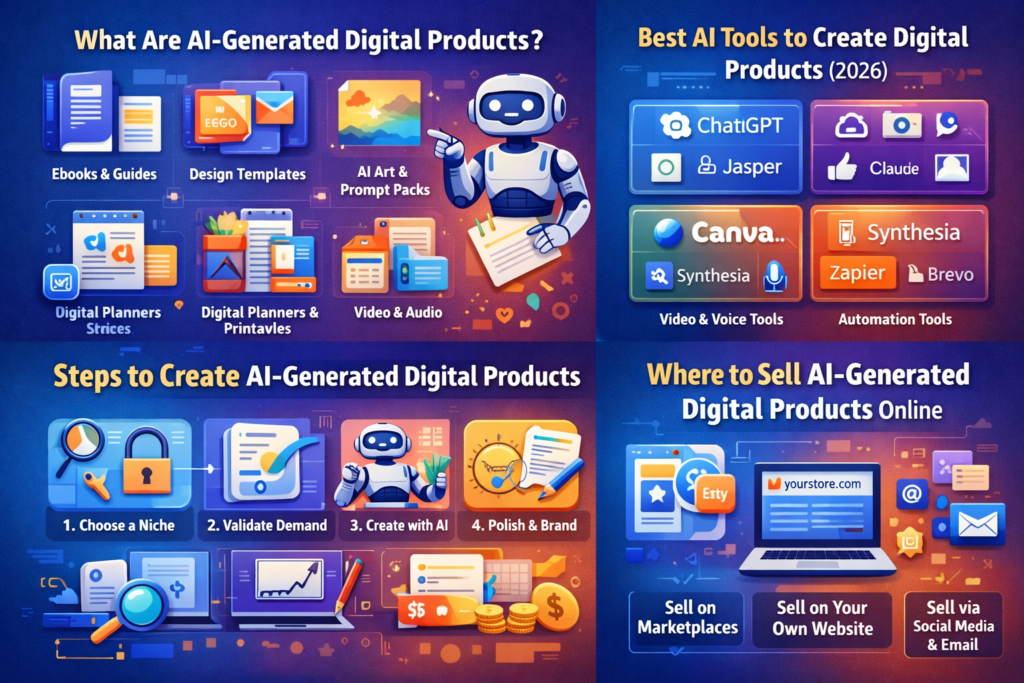
Table of Contents
What Are AI-Generated Digital Products?
AI-generated digital products are items created primarily using artificial intelligence tools. They are digital files that customers can download instantly after purchase.
Think of AI automation as your creative assistant. You provide the direction, and AI handles the heavy lifting of writing, designing, or coding. Here are common examples:
- Ebooks & Guides: AI writing assistants can draft comprehensive books on any topic.
- Design Templates: Social media graphics, Canva templates, and logos.
- AI Art & Prompt Packs: Curated collections of prompts for tools like Midjourney to generate specific art styles.
- Digital Planners & Printables: Calendars, journals, and organizational sheets.
- Video & Audio Assets: Stock footage, background music, or voiceovers synthesized by AI.
- Code Snippets & Scripts: Automatically generated code for websites or apps.
- Online Courses & Worksheets: Content and structure drafted by AI for you to polish.
The beauty lies in scalability and low cost. Once created, you can sell the same product file endlessly.
“Spent hours creating AI products but have nowhere to sell them? Get your professional website live in 30 minutes with Hostinger (use code AI2026 for 80% off) and start selling today.”
https://hostinger.in?REFERRALCODE=CM8MK7508CRS
Why AI-Generated Digital Products Are the Future of Online Earning
The shift towards AI-generated products isn’t a trend; it’s a fundamental change in how digital businesses operate.
- Automation = Scalability: AI lets you produce more products in less time. What took a week now takes an afternoon.
- True Passive Income Potential: After the initial creation and setup, sales can happen automatically while you sleep.
- Extremely Low Investment: You don’t need a warehouse, shipping, or raw materials. Your main costs are AI tool subscriptions (often very affordable).
- Borderless Global Reach: A creator in Mumbai can sell to a customer in New York with ease. Platforms handle currency and payments.
Best AI Tools to Create Digital Products (2026)
The right tools make all the difference. Here’s a categorized breakdown of the best AI tools for digital products in 2026.
AI Tools for Writing Products
These tools help you create ebooks, blog posts, sales copy, and course content.
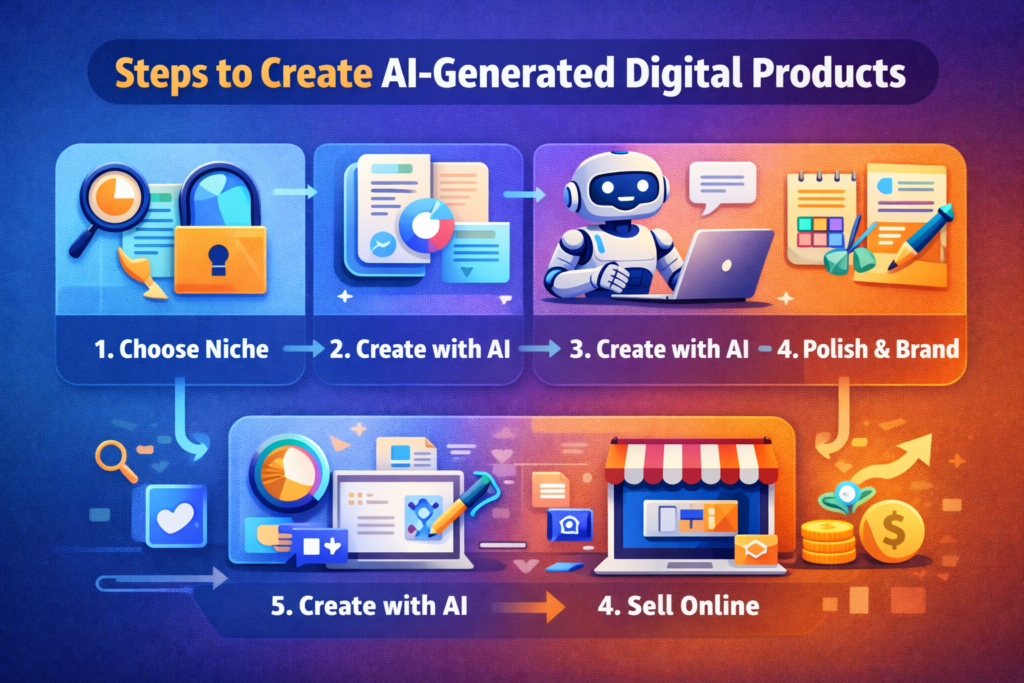
- ChatGPT / Advanced Language Models: Perfect for brainstorming, drafting long-form content, and creating structured outlines.
- Claude (Anthropic): Excellent for nuanced, high-quality writing that requires careful reasoning.
- Jasper.ai: A specialized tool for marketers to create persuasive product descriptions and advertising copy.
- GrammarlyGO: Integrates with your writing process to polish and refine AI-generated text for a human touch.
AI Tools for Design & Templates
Turn ideas into visual assets without needing to be a professional designer.
- Canva AI & Magic Studio: Features like Magic Design, AI Image Generator, and template suggestions make design effortless.
- Midjourney / DALL-E 3: The leaders in generating stunning, high-quality AI art and graphics from text prompts.
- Adobe Firefly: Integrated into the Creative Cloud, ideal for creating commercially safe images, vectors, and text effects.
AI Tools for Video, Audio & Voice Products
Expand into multimedia with these accessible tools.
- Synthesia / HeyGen: Create professional AI avatar videos from a text script—no camera or filming needed.
- ElevenLabs: Generate incredibly realistic AI voiceovers in multiple languages and accents.
- CapCut / Pictory.ai: Automatically edit long videos into short clips, add subtitles, and create engaging content.
AI Automation Tools for Scaling
These tools help you run your business on autopilot.
- Zapier / Make: Connect your apps. Example: Automatically email a product download link when a payment is received.
- AI-Powered Chatbots (like Landbot): Provide customer support and guide buyers on your website 24/7.
- Email Marketing Automation (ConvertKit, Brevo): Use AI to segment your audience and send personalized product follow-up sequences.
Step-by-Step: How to Create AI-Generated Digital Products
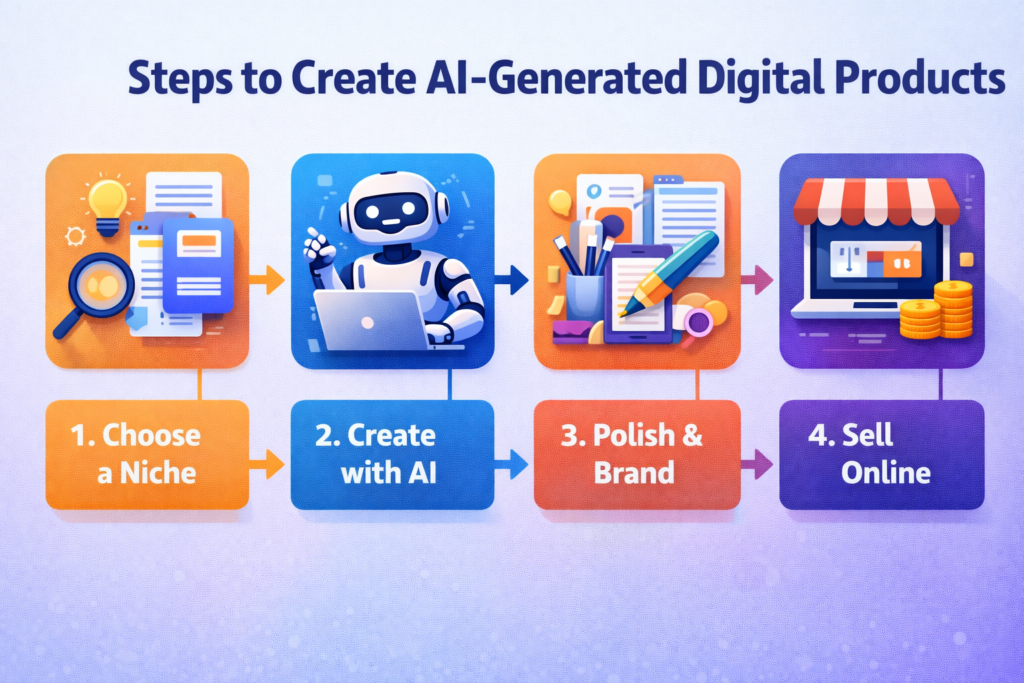
Follow this simple, five-step framework to go from idea to income.
Step 1 – Choose a Profitable Niche
Don’t be too broad. A focused niche has less competition and a more targeted audience.
- Beginner-Friendly Niches: Digital planners for students, social media templates for small businesses, recipe ebooks for air fryers, meditation guides.
- How to Choose: Combine your interest with market demand. Use tools like Google Trends or marketplace search bars (Etsy, Gumroad) to see what’s popular.
Step 2 – Validate Demand
Before creating anything, ensure people will buy it.
- Search on Platforms: Look for similar products on Etsy, Gumroad, or Shopify. Are there many reviews? That’s a good sign of demand.
- Use Keyword Tools: Free tools like Google Keyword Planner or Ubersuggest can show search volume for your topic.
- Ask Your Network: Poll potential customers in Facebook groups or Reddit communities about their needs.
Step 3 – Create Product Using AI
This is where AI automation shines.
- Outline with AI: Prompt: *”Create a detailed 10-chapter outline for an ebook about [your niche].”*
- Generate Content: Prompt: *”Write a 500-word section for Chapter 3 about [specific subtopic] in a beginner-friendly tone.”*
- Create Visuals: Use Canva AI or Midjourney to generate cover art, interior graphics, or template designs.
- Compile: Assemble all AI-generated content into a coherent document (Google Docs, Canva PDF).
Step 4 – Polish & Brand the Product
AI provides the draft; you provide the value. This step is non-negotiable.
- Edit and Personalize: Read through everything. Add personal stories, examples, and your unique voice.
- Ensure Consistency: Check formatting, fonts, and color schemes.
- Create a Brand: Design a simple logo and choose a product name that resonates.
Step 5 – Price Your Product
Pricing can make or break your sales.
- Competitor Analysis: See what similar products are priced at.
- Value-Based Pricing: Price based on the transformation or solution you provide. A template that saves 10 hours of work can be priced at $20-$50.
- Tiered Pricing: Offer a basic product, a premium bundle, and a deluxe package with extras.
Best AI-Generated Digital Product Ideas for Beginners
Start with these low-skill, high-demand AI digital product ideas:
- Printable Planners & Journals: AI designs the layout; you customize the aesthetics.
- Niche “How-To” Guides/Ebooks: Use AI to research and draft comprehensive guides (e.g., “Instagram Growth for Artists in 2026”).
- Social Media Content Kits: Packs of pre-written captions and matching AI-generated graphics for specific themes.
- AI Art Prompt Collections: Curate and sell packs of effective prompts for popular AI art models.
- Email Signature Templates: Professionally designed templates created in Canva with AI assistance.
- Digital Stickers & Clipart: Unique AI-generated art sold for use in digital planners or projects.
- Lightroom Presets / Filter Packs: While creation needs some skill, AI can help analyze trends and name/describe presets compellingly.
Where to Sell AI-Generated Digital Products Online
You have three main avenues to sell AI-generated products online.
Sell on Marketplaces (Etsy, Gumroad, etc.)
- Pros: Built-in traffic, easy setup, trusted payment systems.
- Best For: Beginners starting their online earning journey.
- Top Platforms:
- Etsy: Ideal for printables, templates, and digital art. Huge audience looking for digital downloads.
- Gumroad: Super simple, no upfront fees. Great for ebooks, courses, and software.
- Creative Market / TemplateMonster: For high-quality design assets and website templates.
Sell on Your Own Website
- Pros: Full control, higher profit margins, build your brand.
- Best For: Those serious about building a long-term AI automation business.
- How to Start: Use user-friendly platforms like Shopify, WordPress with WooCommerce, or Carrd to build your store.
Sell via Social Media & Email
- Method: Use platforms like Instagram, Pinterest, or LinkedIn to drive traffic directly to your Gumroad link or website.
- Power Move: Build an email list from day one. Offer a free AI-generated lead magnet (like a mini-planner) in exchange for an email address to market future products.
How to Automate Sales Using AI
Turn your store into a 24/7 sales machine.
- AI Sales Funnels: Tools like GetResponse or Kartra use AI to recommend the best funnel structure for your product type.
- Email Automation: Set up automated sequences (welcome series, cart abandonment, post-purchase follow-up) that are personalized by AI.
- AI Chatbots: Install a chatbot on your website to answer common customer questions about your AI digital products, guiding them to purchase.
- Payment & Delivery Automation: Platforms like Gumroad or SendOwl automatically handle payment processing, file delivery, and VAT/taxes.
Legal & Copyright Things to Know (India + USA)
This is crucial for long-term success.
- AI Content Rights: In 2026, always check the Terms of Service of your AI tool. Most grant you commercial rights to outputs, but some have restrictions. Never claim direct copyright on raw, unedited AI output.
- Your Edit is Key: Adding substantial human creativity, editing, and arrangement strengthens your copyright claim. You are selling a finished product, not the raw AI output.
- Platform Rules: Marketplaces like Etsy require you to disclose the use of AI in your product creation if relevant. Be transparent.
- Best Practice: Use AI as a collaborator. Your unique compilation, branding, and expertise are what you truly sell.
Common Mistakes Beginners Make (And How to Avoid Them)
- Selling Raw AI Output: This creates low-value products. Always edit, refine, and package.
- Ignoring SEO: Your product title and description need keywords to be found. (More on this below).
- Pricing Too Low: Undervaluing your work hurts the market and your profits. Charge for the value.
- No Marketing: “Build it and they will come” doesn’t work. Plan to promote on at least one social platform.
- Skipping Validation: Don’t spend weeks creating a product no one is searching for. Validate first.
How Much Money Can You Make Selling AI-Generated Digital Products?
Income varies wildly based on effort, niche, and marketing. Here’s a realistic breakdown:
| Product Type | Beginner (Months 1-3) | Consistent Creator (6+ Months) | Top Sellers / Scalers |
|---|---|---|---|
| Low-Ticket Items (Templates, Printables) | $50 – $300/month | $500 – $2,000/month | $5,000+/month |
| Mid-Ticket Items (Ebooks, Courses) | $0 – $200/month | $1,000 – $5,000/month | $10,000+/month |
| High-Ticket/Service (Custom AI Automation) | $0 – $100/month | $2,000 – $8,000/month | $15,000+/month |
Timeline Expectations: Month 1-2 are for learning and launching. Months 3-6 are for optimizing and marketing. Passive income with AI builds over time as you add more products to your catalog.
SEO Tips to Rank AI Digital Products on Google
To get free, long-term traffic, optimize for search engines.
- On-Page SEO: Include your main keyword (“AI-generated digital products”) in your product title, description, and filename (e.g.,
ai-meditation-planner-canva-template.pdf). - Keyword-Rich Descriptions: Write detailed, helpful product descriptions that naturally use LSI keywords like “passive income with AI” or “AI tools for beginners.”
- Internal Linking: If you have a blog, link to your product pages. If you have multiple products, link between them.
- Aim for Featured Snippets: Create a companion blog post answering a common question (e.g., “How to use a digital planner”) and structure the answer clearly with headers. Link to your product within the post.

- Processor, Memory & Storage: QC Snapdragon X1-26-100 (up to 3GHz max boost clock, 30 MB L3 cache, 8 cores, 8 threads)| M…
- Operating System & Preinstalled Software: Windows 11 Home Single Language | MS Office Home 2024 |1 year Microsoft 365 Ba…
- Display & Graphics: 14” 2K (1920×1200) OLED Brightview Low Blue Light 300 nits|Graphics: Qualcomm Adreno GPU
Final Thoughts: Is Selling AI-Generated Digital Products Worth It in 2026?
Absolutely. The convergence of advanced, accessible AI and global digital marketplaces has created an unprecedented opportunity. For beginners in India and the USA, the barriers to entry have never been lower. The key is to start—not with perfection, but with one simple product. Use AI automation as your powerful ally, but infuse every product with your unique perspective and polish.
The future of online earning belongs to those who leverage technology to create value efficiently. Your journey to creating and selling AI digital products starts today.
Q1: What exactly are AI-generated digital products?
AI-generated digital products are downloadable files (like ebooks, templates, art, or courses) primarily created using artificial intelligence tools. You guide the AI with prompts and instructions, and it handles the bulk of the writing, designing, or coding, which you then edit, package, and sell.
Q2: Do I need technical skills or coding knowledge to start?
No, you don’t need any technical or coding skills. The modern AI tools for digital products are designed for beginners. They use simple text prompts and have intuitive interfaces. The key skills are creativity, basic editing, and understanding your audience’s needs.
Q3: Is it legal to sell content created by AI?
Yes, but with important caveats. In 2026, most major AI tool terms of service grant you a license to use and sell the outputs commercially. However, you must significantly edit, arrange, and brand the raw AI output. You are selling your unique final product, not the raw AI-generated text or image. Always check the specific tool’s terms and disclose AI use if required by platforms like Etsy.
Q4: How much money can a beginner realistically make?
A beginner can realistically expect to make $50-$500 in their first few months by selling low-cost items like templates or printables. With consistent effort—creating multiple products, learning basic marketing, and understanding SEO—you can scale this to a steady $1,000-$3,000 per month passive income stream within 6-12 months.
Q5: Which platform is best for beginners to sell their first product?
For absolute beginners, Gumroad is highly recommended for ebooks and guides, and Etsy is best for printables, templates, and digital art. Both have massive built-in traffic, are simple to set up, and handle payments and file delivery automatically, allowing you to focus on creation.
RELATED POSTS
View all


How to Automatically Sort Emails in Gmail Using AI (Step-by-Step Guide)
December 23, 2025 | by mk75089317@gmail.com

Stripe India Account Setup & Payment Acceptance Guide (2026 Complete Guide)
February 5, 2026 | by mk75089317@gmail.com
What Is YouTube Automation? How to Make Money with YouTube Automation in 2026 (Complete Beginner Guide)
December 29, 2025 | by mk75089317@gmail.com