

AI Automation Trends 2026: The Game-Changing Shift to Adopt
January 17, 2026 | by mk75089317@gmail.com
AI automation trends 2026 mark the end of speculation and the start of systemic integration. We are now entering the phase where automation is the baseline for operational viability, not just an advantage. The convergence of powerful models and deep workflow understanding creates an unstoppable force for business.
Companies that ignore these AI automation trends face existential threats: unsustainable costs, slow decision-making, and an inability to meet demands for instant, personalized service. This is not about getting ahead—it’s about survival. The future of AI automation is here, defining the next two years.
Here are the 10 trends that will dominate 2026–2027.
Table of Contents
1. AI Automation Trends 2026: The Autonomous Agent Ecosystem
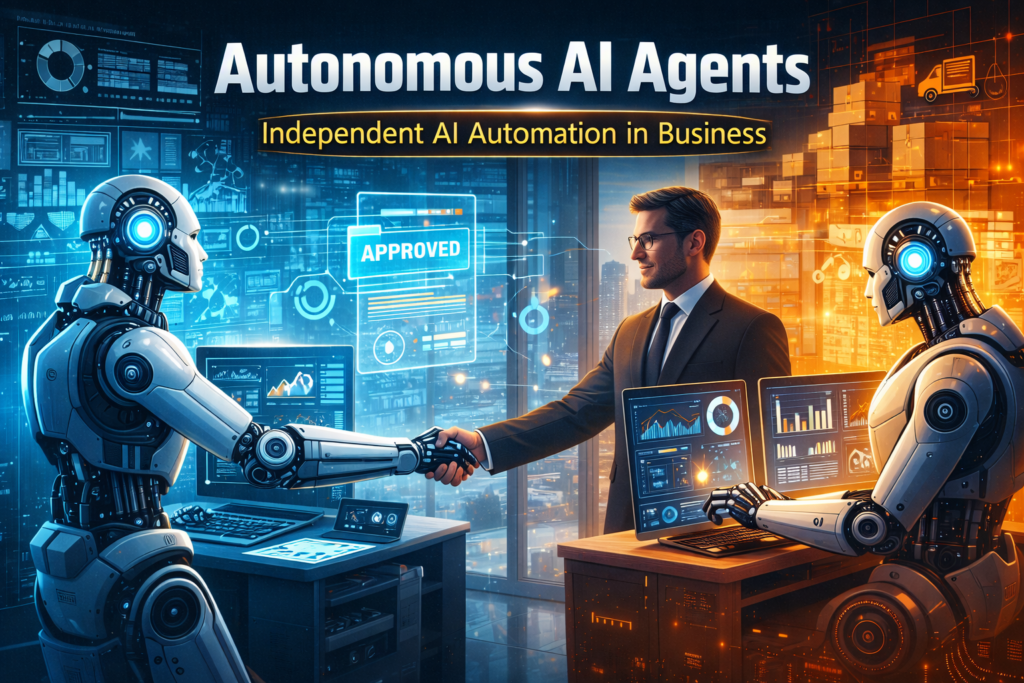
Explanation: Move beyond single-task bots. Autonomous AI agents can perceive, plan, act, and learn. They chain complex tasks across multiple platforms without constant human input.
Real-World Use Case: An e-commerce agent monitors inventory, predicts shortages, negotiates with suppliers, places orders, and adjusts marketing campaigns in one continuous operation.
Benefits:
- End-to-end process automation
- Major reduction in process delay
- Captures complex, multi-step business logic
Risks & Limitations:
- High setup complexity and cost
- Risk of “agent sprawl” and chaos
- Significant danger if goals are misinterpreted
Who Should Adopt: Tech-forward enterprises, scaling startups, logistics companies.
McKinsey: The State of AI in 2026
2. Hyper-Personalization at Scale Through Dynamic Workflows
Explanation: Static automation is dead. AI workflows now reconfigure themselves in real-time for each customer using live data, personalizing every step.
Real-World Use Case: A bank’s loan process dynamically adjusts requested documents and questions based on the applicant’s unique financial profile.
Benefits:
- Unprecedented customer experience
- Optimal resource allocation
- Data collection becomes personalized
Risks & Limitations:
- Needs robust, clean data pipelines
- Creates regulatory complexity
- Hard to audit “dynamic” decisions
Who Should Adopt: Marketing agencies, SaaS, financial services, e-commerce.
Gartner: Top 10 Low-Code Development Platforms
3. AI-Native Process Discovery & Redesign
Explanation: New AI automation tools don’t just execute; they discover. By analyzing digital activity, they map inefficiencies and suggest optimal redesigns.
Real-World Use Case: A consultant uses AI to analyze report preparation, finds a 40% time waste, and auto-proposes a new, integrated workflow.
Benefits:
- Eliminates guesswork in planning
- Uncovers hidden inefficiencies
- Continuously optimizes processes
Risks & Limitations:
- Employee privacy concerns
- May prioritize efficiency over judgment
- Output depends on input data quality
Who Should Adopt: Large enterprises, operations managers, business consultants.
World Economic Forum: AI Governance Toolkit
4. No-Code/Low-Code AI Automation for Every Employee
Explanation: Democratization peaks. Intuitive, drag-and-drop platforms let non-technical staff build and deploy sophisticated automations for team-specific needs.
Real-World Use Case: An HR manager builds a no-code agent that screens resumes, schedules interviews, and onboard hires without code.
Benefits:
- Solves departmental problems fast
- Reduces IT backlog, empowers experts
- Fosters innovation culture
Risks & Limitations:
- Can create shadow IT and security risks
- Potential for poorly designed automations
- Critical need for governance
Who Should Adopt: SMBs, agencies, department heads, entrepreneurs.
5. Predictive Workflow Intervention
Explanation: Automation moves from reactive to predictive. AI analyzes patterns to initiate workflows before a problem occurs or an opportunity is lost.
Real-World Use Case: Manufacturing AI predicts machine failure. It auto-generates a work order, assigns a tech, orders the part, and reschedules production pre-breakdown.
Benefits:
- Transforms operations into profit drivers
- Near-elimination of downtime
- Shifts human role to oversight
Risks & Limitations:
- High dependency on accurate predictions
- Risk of over-automation and alert fatigue
- Needs significant IoT/data infrastructure
Who Should Adopt: Manufacturing, utilities, IT operations, supply chain.
6. Sovereign & Vertical-Specific AI Automation Models
Explanation: The generic model fades. Specialized, pre-trained models for specific industries (legal, healthcare) ensure higher accuracy and built-in compliance.
Real-World Use Case: A law firm uses a sovereign “Legal Ops” model to automate document discovery, contract review, and billing with legal understanding.
Benefits:
- Higher accuracy out-of-the-box
- Built-in regulatory guardrails
- Faster ROI with less training
Risks & Limitations:
- Potentially high cost
- Can create data silos
- Risk of narrow-dataset bias
Who Should Adopt: Regulated industries, professional services, enterprises with unique data.
7. Human-AI Teaming with Emotion & Context Sensing
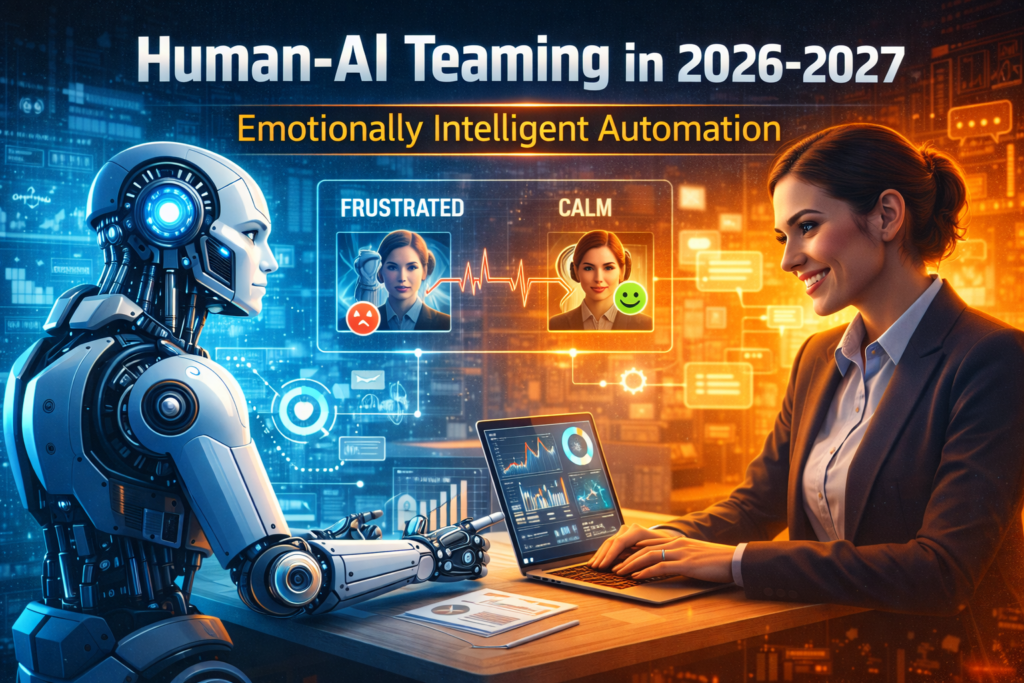
Explanation: Automation gains emotional intelligence. AI senses human context (stress, confusion) and adjusts its interaction style to optimize team output.
Real-World Use Case: Support AI detects customer frustration, escalates the case, briefs the human agent, and adopts a more empathetic tone.
Benefits:
- Smoother human-AI collaboration
- Improved customer/employee satisfaction
- AI becomes a true “teammate”
Risks & Limitations:
- Major ethical and privacy concerns
- Potential for manipulation
- Nascent, sometimes inaccurate technology
Who Should Adopt: Customer-facing industries, human resources, high-stress teams.
8. Ubiquitous Ambient Automation
Explanation: Automation disappears into the background. It’s embedded in environments, triggered by context, presence, or conversation.
Real-World Use Case: Entering a smart room auto-loads your presentation, dials participants, and adjusts lights. “Let’s recap” triggers AI minutes.
Benefits:
- Frictionless, intuitive experience
- Proactive, invisible assistance
- New levels of productivity
Risks & Limitations:
- Severe constant monitoring concerns
- Massive IoT investment required
- Can feel intrusive if imperfect
Who Should Adopt: Smart office builders, hospitality, advanced retail.
9. Automated AI Governance & Compliance Auditing
Explanation: Governing vast automation is impossible manually. Automated systems now monitor other AIs for bias, drift, and security, ensuring ethical operations.
Real-World Use Case: A bank’s governance AI continuously audits thousands of loan automations, flagging any that develop bias or violate new rules.
Benefits:
- Enables safe, scalable deployment
- Real-time compliance and risk mitigation
- Builds essential trust
Risks & Limitations:
- “Who watches the watchers?” problem
- False sense of security risk
- Adds cost and complexity
Who Should Adopt: Any regulated business scaling AI, public sector, finance, healthcare.
10. Generative AI in the Core Operational Fabric
Explanation: Generative AI moves from a toy to the core engine. It dynamically generates automation code, creates training data, drafts documents, and designs processes within workflows.
Real-World Use Case: Describe a product feature. GenAI drafts the spec, generates test code, creates a marketing brief, and updates the project timeline—all linked.
Benefits:
- Breaks barrier between idea and execution
- Drastically accelerates innovation
- Automates the creation of automations
Risks & Limitations:
- Hallucinations in critical processes
- IP and ownership questions
- Over-reliance without deep understanding
Who Should Adopt: Software developers, R&D, product managers, content businesses.
Conclusion: Building the Invisible Engine
The AI automation trends 2026 reveal a clear future: automation is becoming the invisible, ambient engine of business. It’s shifting from task-oriented to outcome-oriented.
Looking beyond 2027, “AI automation” will simply be “how business operates.” The competition will focus on the quality of a company’s automated intelligence—its ethics, creativity, and human synergy. The foundation for that decade must be built now. Businesses understanding this are not just planning for two years; they are architecting their future.

- Processor : AMD Ryzen 3 7320U Processor 2.4GHz (6MB Cache, up to 4.1GHz, 4 cores, 8 Threads)
- Display : 14.0-inch, FHD (1920 x 1080) 16:9 aspect ratio, 60Hz refresh rate, 250nits Brightness | Keyboard : Chiclet Key…
- Graphics : Intergrated AMD Radeon Graphics
1. Which types of businesses need these 2026 AI automation trends the most?
Businesses of all scales will benefit, but tech-forward enterprises, scaling startups, and heavily-regulated industries (like finance and healthcare) will see the most immediate and transformative impact. SMBs and agencies can also gain quick wins from trends like No-Code tools and hyper-personalization.
2. Can small businesses (SMBs) afford these advanced AI automation trends?
Absolutely. The rise of No-Code/Low-Code platforms (Trend #4) and accessible Generative AI tools (Trend #10) has dramatically lowered the barrier to entry. Many powerful automation tools operate on a subscription (SaaS) model, making them affordable without large upfront investments in IT infrastructure.
3. What’s the biggest risk in adopting these AI automation trends?
The single biggest risk is poor governance and a lack of human oversight. Trends like Autonomous Agents (#1) and Predictive Intervention (#5) can lead to significant errors or “agent sprawl” if not properly monitored. Implementing Automated AI Governance (Trend #9) alongside any new automation is now considered a critical best practice.
4. How is “AI automation” in 2026 different from the “RPA” (Robotic Process Automation) we used before?
Earlier RPA was largely rule-based, brittle, and handled repetitive, structured tasks. The future of AI automation in 2026-2027 is cognitive, adaptive, and handles unstructured data. It involves AI that can understand context, make predictions, learn from outcomes, and manage dynamic workflows—going far beyond simple rule-following.
5. What’s the first step a company should take to prepare for these trends?
Start with AI-Native Process Discovery (Trend #3). Before investing in any tool, use AI to audit your current workflows. This identifies the highest-impact, most inefficient processes ripe for automation, ensuring your first investment delivers clear ROI and provides a blueprint for a strategic, company-wide rollout.
Ready to Build Your AI Automation Stack?
Implementing these trends requires a reliable, high-performance hosting foundation for your AI tools, apps, and data pipelines. For our readers, Hostinger offers an optimized platform to run automation scripts, AI models, and business apps seamlessly.
👉 Use code https://hostinger.in?REFERRALCODE=CM8MK7508CRS for an extra discount on Hostinger’s AI-friendly hosting plans.
RELATED POSTS
View all

AI Automation Business Ideas to Start in 2026
January 18, 2026 | by mk75089317@gmail.com

Smart Blogging & SEO Strategies for Sustainable Growth
December 19, 2025 | by mk75089317@gmail.com

Start Freelancing in 2026 with Zero Experience: The #1 Beginner’s Blueprint
January 24, 2026 | by mk75089317@gmail.com