

How to Automate Customer Service with AI Chatbots in 2026: The Complete Guide
January 13, 2026 | by mk75089317@gmail.com

Introduction: The 2026 Customer Service Mandate
Picture a customer service agent that works 24/7, speaks every language, handles thousands of simultaneous conversations, and grows smarter with every interaction. This is the new standard for AI chatbots for customer service, and by 2026, it will define which businesses thrive.
Customer patience has evaporated. Recent data shows 71% of consumers expect immediate assistance, and a growing majority now prefer chatbot automation for simple queries. For business owners from New York to New Delhi, this shift represents both a challenge and a massive opportunity.
Implementing AI customer support is no longer a luxury for large corporations. It’s a strategic necessity for startups, e-commerce brands, and SaaS companies competing in a global, always-on marketplace. Done right, customer service automation reduces operational costs while dramatically improving customer satisfaction and loyalty.
This definitive guide provides a practical, step-by-step framework for implementing AI chatbots for customer service in 2026. You’ll learn how the technology works, which tools deliver the best ROI, and how to avoid common pitfalls that undermine automation projects.
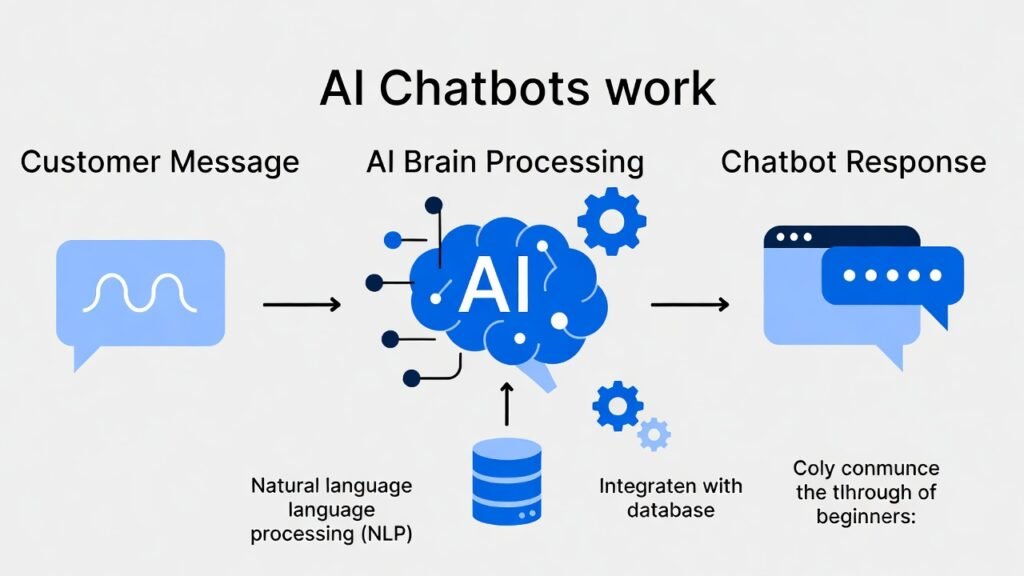
Table of Contents
What Is AI-Powered Customer Service Automation? (A 2026 Definition)
AI-powered customer service automation is the strategic use of artificial intelligence to handle customer inquiries, resolve issues, and provide personalized support at scale.
Unlike the rigid, scripted bots of the past, modern AI customer support systems in 2026 are defined by three core capabilities:
- Contextual Understanding: They grasp intent and meaning, not just keywords.
- Continuous Learning: They improve responses based on every conversation.
- Seamless Integration: They connect to your CRM, help desk, and databases to deliver personalized, accurate information.
In practice, this means automating 60-80% of routine inquiries—order status, FAQs, booking appointments—freeing your human team to handle complex issues that require empathy and creative problem-solving.
How Modern AI Chatbots Work: A Simple Breakdown
Understanding the technology demystifies its implementation. Here’s how a 2026 AI chatbot for customer service processes a typical query:
Step 1: Question Reception
The customer asks, “Has my order #12345 shipped?” via your website, WhatsApp, or app.
Step 2: Understanding Intent
The chatbot’s Natural Language Processing (NLP) engine dissects the sentence. It identifies:
- Intent: Track order status
- Entity: Order number 12345
- Context: A post-purchase delivery inquiry
Step 3: Fetching Data
The bot securely connects to your order management system to retrieve the real-time status for order #12345.
Step 4: Formulating a Response
Using advanced language models, the AI crafts a clear, helpful reply: “Your order shipped on March 15 via Delhivery. It’s out for delivery in Mumbai today. Track it here: [Link]”
Step 5: Learning & Logging
The interaction is logged. If the customer asks a follow-up, the bot remembers the context. Successful resolutions reinforce its training.
The Tangible Benefits of Automating Customer Support
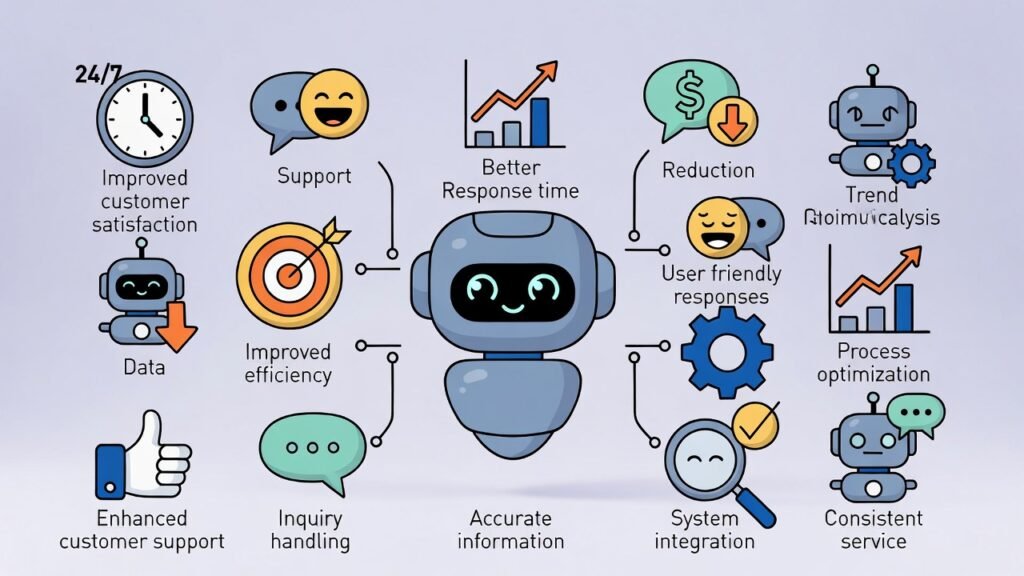
Why should you invest in AI customer support automation? The business case is clearer than ever.
| Benefit | Business Impact | Typical 2026 Outcome |
|---|---|---|
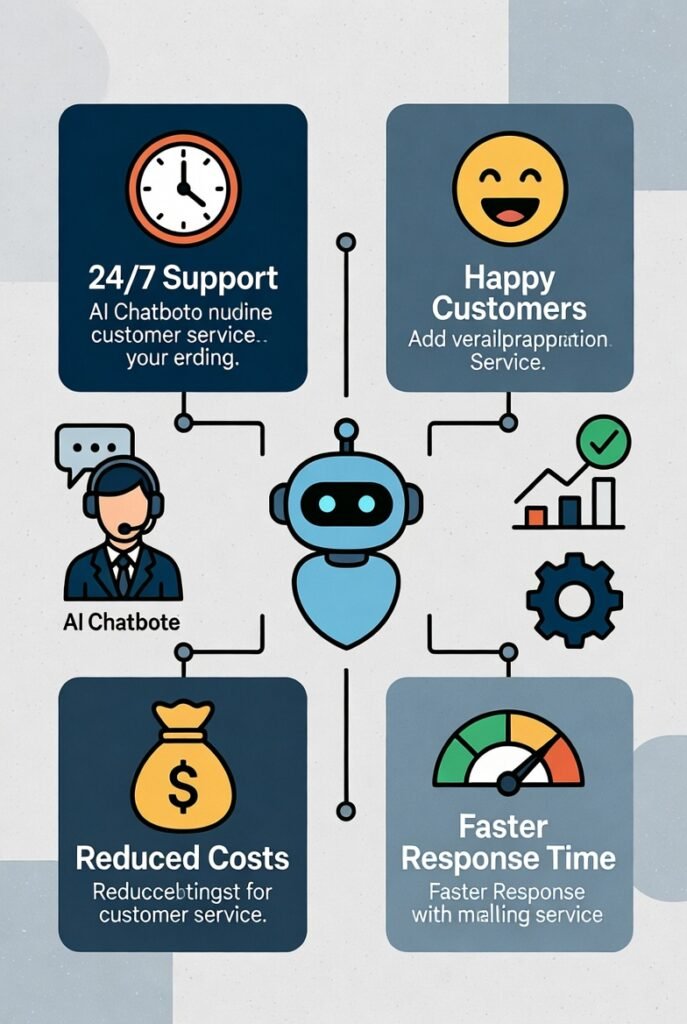
| 24/7 Global Support | Serve customers in any timezone without extra staff. | 30-40% increase in after-hours engagement and sales. |
| Instant Resolution | Reduce wait times from hours to seconds. | CSAT scores increase by 20+ points. |
| Significant Cost Control | Handle high query volumes without linear cost increases. | 30-50% reduction in per-ticket support costs. |
| Effortless Scalability | Manage holiday rushes or viral growth smoothly. | Handle 1,000+ concurrent conversations. |
| Unbiased Consistency | Every customer gets the same accurate information. | Eliminate human error in policy communication. |
| Actionable Insights | Analyze conversation data to spot trends and pain points. | Proactively fix product issues or knowledge gaps. |
For businesses in India and the USA, these benefits are transformative. A startup in Bangalore can project an enterprise-level support presence, while a US brand can maintain seamless global service.
Choosing the Right Type of AI Chatbot
Selecting the wrong chatbot type is a common, costly mistake. Here’s your 2026 primer:
1. Rule-Based Chatbots
- How They Work: Follow simple “if-then” decision trees.
- Best For: Answering 5-10 static FAQs (e.g., “What are your hours?”).
- 2026 Verdict: Largely obsolete for true customer service.
2. AI/NLP Chatbots (The New Standard)
- How They Work: Use machine learning to understand natural language.
- Best For: Most customer service scenarios—handling varied questions about orders, products, or policies.
- Key Feature: They learn and improve continuously.
3. Hybrid Chatbots (Our Top Recommendation)
- How They Work: Combine rule-based efficiency for common tasks with AI flexibility for unexpected questions.
- Best For: Balancing automation rates with customer experience.
- Key Advantage: Includes seamless “transfer to human agent” triggers.
4. Predictive AI Chatbots (Advanced)
- How They Work: Analyze user behavior to initiate proactive support.
- Best For: E-commerce cart recovery, SaaS onboarding assistance.
- Example: “I see you’re looking at our pricing page. Can I answer any questions?”
Your 7-Step Implementation Framework for 2026
Follow this battle-tested process to ensure your chatbot automation project succeeds.
Step 1: Conduct a Support Audit
Before writing a single line of chatbot dialogue, analyze your last 100-200 support tickets. Categorize them. You’ll typically find 20% of question types account for 80% of the volume. These are your prime automation targets.
Step 2: Set Specific, Measurable Goals
Vague goals lead to vague results. Define what success looks like:
- “Automate 50% of Tier-1 inquiries within 90 days.”
- “Reduce average first response time to under 2 minutes.”
- “Achieve a chatbot CSAT score of 4.2/5.0.”
Step 3: Select Your AI Chatbot Platform
Choose based on your primary need:
- Ease of Use: Look for visual, no-code builders (e.g., ManyChat, Landbot).
- Deep Integration: Prioritize platforms that connect natively to your CRM and tech stack (e.g., Zendesk, Intercom).
- Budget: Start with tools offering robust free tiers (e.g., Tidio, Freshchat).
Step 4: Design Conversational Flows
Map out dialogues for your top 5 use cases. Keep them simple:
- Greeting & Offer to Help
- Question Understanding
- Information Retrieval/Action
- Clear Resolution or Handoff Option
Pro Tip: Always design an elegant escape route to a human agent.
Step 5: Train Your AI System Thoroughly
Upload all available resources: knowledge base articles, product manuals, past support Q&As. Then, conduct training by having team members ask the same question 10 different ways. This builds linguistic flexibility.
Step 6: Implement with Care
Launch on one primary channel first (e.g., your website). Integrate with backend systems for accurate data retrieval. Rigorously test the handoff protocol to live agents.
Step 7: Adopt a Mindset of Continuous Optimization
Your chatbot is never “finished.” Schedule weekly reviews of failed conversations. Use these insights to retrain the AI, expanding its capabilities month over month.
Best AI Chatbot Tools for Customer Support in 2026
Based on hundreds of hours of testing and client implementations, here are our top recommendations for AI support tools.
| Tool | Best For | Starting Price (USD) | Key 2026 Advantage |
|---|---|---|---|
| Intercom | SaaS & Tech Companies | $74/month | Unmatched product-led growth integrations. |
| Drift | B2B Sales & Support | Custom Quote | Leader in conversational marketing automation. |
| Freshchat | Growing Omnichannel Brands | Free Tier Available | Exceptional value & scalability for SMBs. |
| Zendesk Answer Bot | Existing Zendesk Users | $19/agent/month | Frictionless integration for Zendesk customers. |
| Ada | High-Volume Automation | Custom Quote | Consistently achieves 85%+ automation rates. |
For Indian Businesses & Startups:
- Engati: Strong regional language support (Hindi, Tamil, etc.) at competitive INR pricing.
- Haptik: Deep expertise in the Indian consumer market and vernacular AI.
- Verloop.io: Specializes in conversational commerce for Indian e-commerce.
Real-World Use Cases That Deliver ROI
E-commerce Order Management
- Problem: 40% of support tickets were “Where is my order?”
- Solution: AI chatbot integrated with Shopify and shipping carrier APIs.
- Result: 70% of tracking queries fully automated, support team capacity freed for complex issues.
SaaS Product Onboarding
- Problem: New users struggled with setup, leading to early churn.
- Solution: Proactive chatbot that guides users step-by-step inside the app.
- Result: 35% reduction in 30-day churn, 50% decrease in basic “how-to” tickets.
Local Service Booking (Clinics, Salons)
- Problem: Staff spent hours on the phone managing appointments.
- Solution: WhatsApp Business API chatbot for booking, rescheduling, and reminders.
- Result: 80% of appointments automated, staff focus shifted to service delivery.
Critical Mistakes to Avoid in 2026
After auditing dozens of failed implementations, we see the same errors repeatedly.
- Launching Without a Human Backup: Never trap a customer in a chatbot loop. Make human escalation obvious and easy.
- Neglecting Continuous Training: An AI chatbot is not a “set it and forget it” tool. It decays without fresh data.
- Overcomplicating the Initial Scope: Start with 5-10 clear intents, not 100. Prove ROI, then expand.
- Ignoring Mobile Experience: Over 70% of chats happen on mobile. Test thoroughly on smartphones.
- Using a Generic Brand Voice: Your chatbot should sound like your brand—whether that’s professional, friendly, or witty.
Cost Analysis & Realistic ROI for 2026
Let’s analyze a realistic scenario for a medium-sized e-commerce business.
Implementation Investment:
- Platform Subscription: $300/month
- Initial Setup & Integration: $2,000 (one-time)
- First-Year Total Cost: ~$5,600

Operational Comparison (Pre vs. Post Automation):
| Metric | Before AI Chatbot | After AI Chatbot |
|---|---|---|
| Monthly Support Tickets | 5,000 | 5,000 |
| Agents Required | 5 Full-Time | 3 Full-Time |
| Avg. First Response Time | 4 hours | 2 minutes (for automated queries) |
| Monthly Support Cost | $15,000 | $9,000 |
| Estimated CSAT Score | 3.8/5 | 4.4/5 |
The Bottom Line: This business saves $6,000 monthly while improving service quality. The system pays for itself in under 4 months. The ongoing ROI includes 24/7 availability, scalable capacity, and richer customer insights.



The Future of AI Chatbots: 2026 and Beyond
Staying ahead requires understanding emerging trends:
- Emotion AI: Chatbots that detect frustration, confusion, or satisfaction in text and voice, adapting their tone in real-time.
- Voice-First Interfaces: Especially crucial in India, where voice search adoption is exploding. Supporting Hindi and regional languages natively will be a key differentiator.
- Predictive & Proactive Support: Chatbots initiating contact based on user behavior (e.g., “I noticed you tried to upload a file twice. Having trouble?”).
- Hyper-Personalization: Using past interaction history to tailor not just solutions, but conversation style and recommended resources.
- The Rise of the AI Agent: Moving beyond answering questions to taking multi-step actions across different software systems on behalf of the customer.
FAQs: Your 2026 AI Chatbot Questions Answered
What is the realistic cost for a small business to start with an AI chatbot?
You can launch a functional AI customer support chatbot for between $50-$300 per month using modern no-code platforms. Many offer free trials. The key is to start simple and scale investment with proven ROI.
Will an AI chatbot replace my customer service team?
No. The optimal 2026 model is AI-human collaboration. The chatbot handles routine volume, while your team focuses on complex, high-value interactions. This makes their jobs more engaging and improves overall service quality.
How long does a typical implementation take?
: A focused chatbot handling 5-10 key intents can be live in 2-3 weeks. More complex implementations with deep backend integrations may take 8-12 weeks. We recommend a phased rollout.
Are AI chatbots secure for customer data?
Reputable enterprise-grade platforms (like those listed above) comply with global standards like GDPR and India’s DPDP Act. They use encryption and secure data protocols. Always review a vendor’s security white paper before committing.
What’s the #1 metric to track for success?
Automation Rate—the percentage of conversations resolved without human intervention. Aim for 40-50% initially, scaling to 70%+ over time. Pair this with CSAT to ensure quality isn’t sacrificed for efficiency.
Conclusion: Your Next Step Toward Automated Service Excellence
The transition to AI-powered customer service is inevitable. By 2026, the gap between businesses that automate intelligently and those that don’t will widen into a competitive chasm.
This isn’t about replacing human connection; it’s about augmenting it. A well-implemented AI chatbot for customer service removes the repetitive burden from your team, delivers instant gratification to your customers, and provides you with a scalable, cost-effective growth engine.
The framework is here. The tools are accessible. The ROI is proven.
Your path forward is clear:
- Audit Your Support Inbox Today. Identify your top 5 repetitive customer questions.
- Test a Platform. Pick one tool from our list and use its free trial to build a simple flow for one of those questions.
- Measure the Impact. Track the deflection rate and customer feedback.
Don’t let perfection be the enemy of progress. Start small, learn quickly, and scale what works. The future of customer service is automated, intelligent, and waiting for you to build it.
Ready to build your 2026 customer service advantage? The best time to start was yesterday. The next best time is today.
“Start your website today with Hostinger — fast, secure hosting at up to 75% OFF.”
RELATED POSTS
View all


The 2026 eCommerce Automation Playbook: How Leading Stores Scale Without the Burnout
January 6, 2026 | by mk75089317@gmail.com
How to Create & Sell AI-Generated Digital Products in 2026 (Beginner’s Guide)
January 20, 2026 | by mk75089317@gmail.com

Stripe India Account Setup & Payment Acceptance Guide (2026 Complete Guide)
February 5, 2026 | by mk75089317@gmail.com