AI Content Structure: Your Guide to Perfect Long-Form Blogs
January 12, 2026 | by mk75089317@gmail.com

Let’s be honest. You’ve been told that AI can write your blog posts, but the results feel… generic. They meander. They lack that deep, authoritative punch that makes a reader stay and search engines care.
You’re left with a block of text that needs so much restructuring, it’s easier to start from scratch.
The promise of AI efficiency has become a cycle of frustration. The problem isn’t the AI. It’s the blueprint you’re giving it.
An AI without a detailed, intelligent AI content structure is like a master builder without architectural plans. You get a pile of materials, not a finished, livable home.
This guide is the missing manual. We’re moving beyond basic prompts to a professional, systematic process. You’ll learn to structure long-form content that AI can execute flawlessly.
By the end, you’ll know exactly how to design frameworks that transform AI from a clumsy wordsmith into a precise, powerful publishing partner.
Table of Contents
Who This Guide Is For
This guide is for bloggers, content marketers, freelancers, and solopreneurs who have tried AI writing tools but hit a wall.
If you’re getting output that’s shallow, disorganized, or sounds robotic, this is your playbook. Whether you’re building an affiliate site, a SaaS blog, or your personal brand, you’ll learn the AI content writing strategy to produce authoritative, ranking content efficiently.
What Is AI-Structured Long-Form Content?
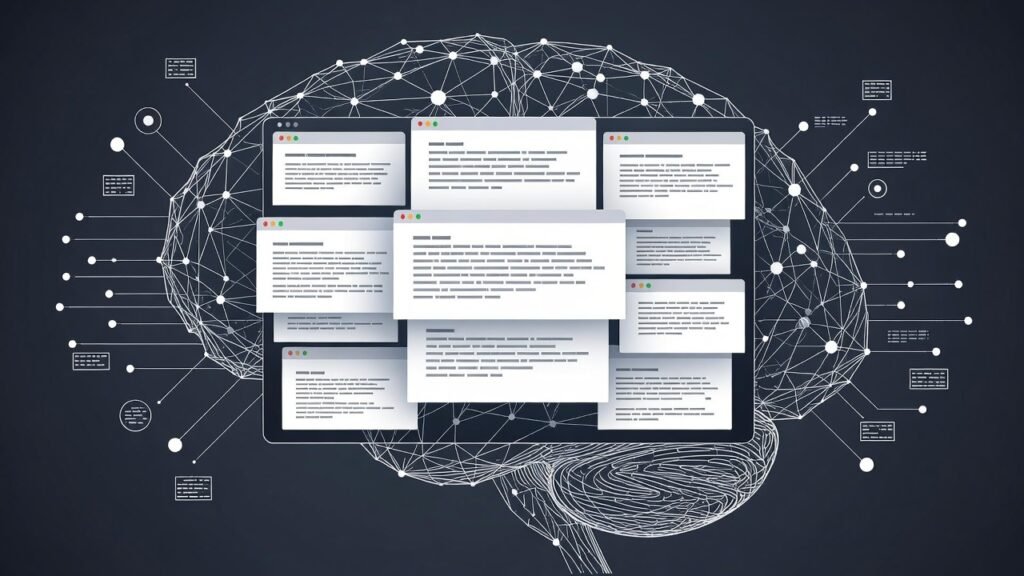
AI-structured long-form content is the process of using strategic prompts and detailed outlines to direct artificial intelligence in creating comprehensive, logically organized articles.
It transforms the AI from a generic text generator into a focused writing assistant that builds content around a human-designed blueprint for depth, clarity, and SEO.
Why AI Content Structure Is Essential for Ranking in 2026
Long-form content is comprehensive, in-depth material that thoroughly explores a topic, typically exceeding 1,500 words. It is designed to be the definitive resource.
It answers not just the main query but all related sub-questions a reader might have.
In 2026, this content type isn’t just popular—it’s essential for ranking. Here’s why:
- Search Engine Sophistication: Algorithms like Google’s Helpful Content Update reward content that demonstrates E-E-A-T. Long-form allows for the depth needed to signal Expertise, Experience, Authoritativeness, and Trustworthiness.
- User Intent Fulfillment: Today’s searchers want a one-stop solution. A well-structured guide keeps them on your page, satisfying their complete search intent.
- Competitive Advantage: As more creators use AI for surface-level content, truly structured, valuable long-form becomes a key differentiator. It builds authority, backlinks, and trust.
This is what AI, guided by a proper long-form blog structure, is uniquely suited to help you produce at scale.
https://developers.google.com/search/docs/fundamentals/creating-helpful-content
The Core Problem: Why AI Content Without Structure Fails
Ask a generic AI to “write a 2000-word blog post on keto diets,” and you’ll get a textbook example of failure. It will likely be:
- Vague and Repetitive: Circling the same points.
- Poorly Organized: Lacking a logical flow or narrative.
- Lacking Depth: Staying on the surface without specifics.
- Soulless and Generic: Having no unique angle or strategic insight.
The AI doesn’t understand context, strategy, or narrative arc. It predicts the next word.
Without a strong AI content structure, it defaults to the most common, average predictions. This results in the bland content plaguing the web. You’re not getting an article; you’re getting a compilation of the most probable sentences.
Bad Prompt vs. Perfect Prompt: The AI Content Structure Difference
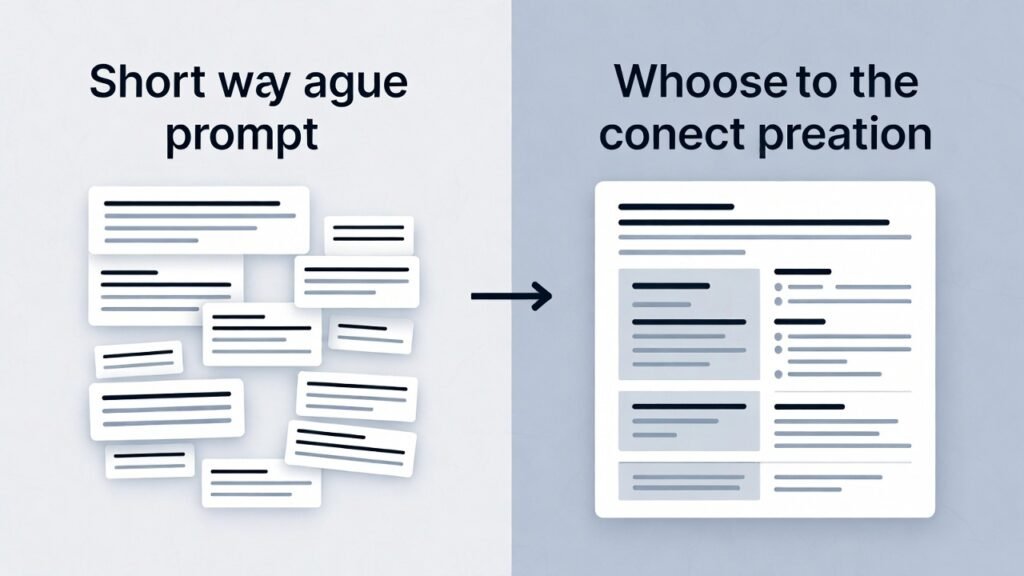
The single biggest leverage point is your prompt. A bad prompt asks for an essay. A perfect prompt provides a detailed architectural plan.
This is the foundation of effective AI prompt engineering for content.
| Bad, Vague Prompt | Perfect, Structured Prompt |
|---|---|
| “Write a blog post about email marketing.” | “Act as an expert B2B SaaS content strategist. Create a detailed outline for a 2,200-word ultimate guide titled ‘The 2026 Guide to Cold Email Outreach That Converts.’ The primary audience is startup founders. Structure the outline with H2 and H3 headings that follow a logical problem-to-solution journey. For each H3, suggest one real-world example and one data point to include. The tone should be direct and professional.” |
| Result: A generic, shallow, unusable draft. | Result: A clear, strategic outline ready for expansion, guiding the AI on role, length, audience, goal, and structure. |
The perfect prompt doesn’t request a final product; it initiates a collaborative process. You are the director and editor; the AI is the researcher and first-draft writer.
Step-by-Step: Build Your AI Content Structure
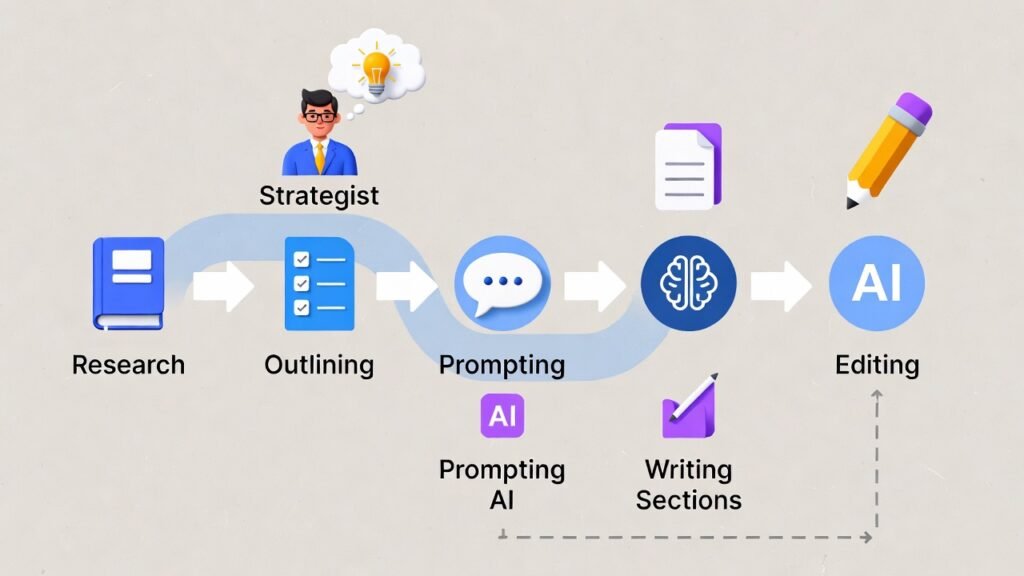
Forget writing with AI from a blank page. Follow this systematic workflow instead. This is your core AI content writing strategy.
Phase 1: Foundation & Strategy (Human-Led)
- Keyword & Intent Research: Find your target primary keyword and cluster relevant semantic keywords. Identify the user’s core search intent.
- Define the Core Angle: What’s your unique take? A “definitive guide,” a “step-by-step tutorial,” or a “problem-solution deep dive”?
- Audience & Goal Clarity: Who is this for? What should they DO after reading?
Phase 2: The AI-Powered Outline Creation
- Craft the “Master Outline Prompt”: Use a detailed framework like the perfect prompt example above.
- Generate & Refine: The AI will produce an outline. You must edit this outline heavily. Rearrange, add, and delete. This is where your expertise creates the logical flow.
Phase 3: Fleshing Out the Structure
- Section-by-Section Expansion: Take your polished outline and prompt the AI to write one H2 section at a time. Provide the context of the overall piece.
- Iterate and Instruct: For each section, guide the tone, demand examples, and ask for simple explanations. This keeps the AI focused.
Phase 4: Human Synthesis & Polish
- Compile and Edit: Bring all sections together. Read through the entire piece as the human editor.
- Inject Personality & Expertise: Add personal anecdotes, unique case studies, or specific insights. Edit for a consistent, human voice.
- Optimize for Readability: Break up text. Add bullet points, bold key sentences, and ensure smooth transitions.
How to Design Outlines That Define Your AI Content Structure
An AI-friendly outline is a hierarchical content map. Think in terms of a logical narrative for your SEO blog structure.
Use clear H2 and H3 tags in your prompt to train the AI. For example:
H2: Why Your Current Blog Structure is Failing
    H3: The Skimming Reality of Modern Readers
    H3: How Google's Algorithms Parse Page Structure
H2: The 5-Part Blueprint for AI-Ready Outlines
    H3: Part 1: The Foundational Hook
    H3: Part 2: The Logical Progression...
This explicit formatting teaches the AI to think in a structured, hierarchical manner. It mirrors both good writing and good SEO.
Proven Prompt Frameworks for Every Blog Section
Use these specialized prompts to generate high-quality sections from your outline. This is prompt engineering in action.
For a Compelling Introduction:
“Write an introduction for the H2 section ‘[Section Title]’. The introduction must hook the reader by stating a common, painful problem they face. Agitate that problem briefly, then hint at the solution this section will provide. End with a transition sentence. Keep it under 150 words.”
For Authoritative Headings:
“Based on the subtopic ‘[Subtopic Description]’, generate 3 options for an engaging H3 heading. They should include a relevant semantic keyword, be benefit-driven, and be under 60 characters.”
For Clear Explanations:
“Explain the concept of ‘[Complex Concept]’ in simple terms. Assume the reader is a beginner. Use a concrete analogy to make it relatable.”
For Relevant Examples:
“Provide a specific, real-world example of [Principle Being Discussed] in action. Use a scenario involving [Your Target Audience]. Describe the situation, the action taken, and the tangible result.”
For instance, a freelancer writing for US and European clients could prompt the AI to generate contrasting communication examples, ensuring the content resonates across different business cultures without manual rewriting.
5 Common AI Content Structure Mistakes
- Expecting a Finished Product in One Prompt: This is the #1 error. AI is a draft generator, not a one-click publisher.
- Neglecting the Human Editing Pass: Failing to fact-check and add unique insights results in content indistinguishable from everyone else’s AI.
- Ignoring Content Gaps: AI works with existing data. It won’t know about your unique product feature or recent case study unless you add it.
- Forgetting the Content “Skeleton”: Not adding placeholders for images, charts, or pull-quotes leads to a text-heavy, unattractive final piece.
- Keyword Stuffing the Prompt: Writing unnaturally for search engines leads the AI to produce stiff, awkward text. Focus on topic coverage.
The fix is always a better AI content structure, not a better AI model.
“Stop letting clunky hosting slow down your content engine. Get your AI-structured blogs online faster with Hostinger—use code [ https://hostinger.in?REFERRALCODE=CM8MK7508CRS ] for a launch-ready discount.”
How a Strong AI Content Structure Turbocharges SEO
A proper SEO blog structure isn’t just about readability—it’s a core SEO and UX tactic.
- For SEO: Clear header tags create a semantic hierarchy. This helps search engines understand context and relevance. A logical flow covers related keywords naturally, strengthening topical authority.
- For Readability: Short paragraphs, descriptive subheadings, and lists reduce cognitive load. Readers can easily scan, increasing dwell time.
- For User Experience (UX): A predictable, logical journey makes the reader feel guided and satisfied. It answers questions as they arise, reducing bounce rates.
- For Rankings: The combined effect of improved user signals and clearer on-page SEO sends powerful ranking signals to Google.
Structured content is fundamentally more helpful, and helpful content ranks.
Real-World Use Cases: Your AI Content Structure in Action
- Authority Blogging: A food blogger can create an “Ultimate Guide to Sourdough.” It would cover history, science, tools, steps, and troubleshooting—all structured for learning and SEO.
- Affiliate Marketing Sites: Build a “Definitive Buyers Guide.” Structure content around problem identification, comparison criteria, in-depth reviews, and a final recommendation. This builds trust.
- SaaS & B2B Blogs: Create a pillar post on “Marketing Automation.” Cluster it into detailed guides on email workflows, lead scoring, and analytics. This captures broad and long-tail traffic.
Each use case relies on the same core principle: a human-designed AI content structure directing AI execution.

The Future of AI-Driven Long-Form Content
Looking ahead, the divide will widen between those who use AI as a crude text generator and those who use it as a structured content engine.
We’ll see AI become a research partner, analyzing data to suggest optimal outlines. Content structures may become dynamic, adapting to user behavior.
The constant will remain: The human strategist provides the blueprint and unique value. The AI provides scalable execution.
Your ability to structure and direct will become your most valuable skill.
Your AI Content Structure Blueprint Awaits
The journey from a vague idea to a perfect, long-form piece is no longer a solo trek. It’s a structured, strategic build.
By mastering the art of the prompt and the science of the outline, you stop fighting with AI and start directing it.
You become the architect. The AI becomes the builder.
The result is content that doesn’t just fill a word count—it fulfills a purpose. It engages readers, earns trust, and commands attention.
The tool is here. The AI content structure is clear. Now, go build something authoritative.


- Processor:AMD Ryzen 5 5500U | Speed: 2.1GHz (Base) – 4.0GHz (Max) | 6 Cores | 12 Threads
- Display: 15.6″ FHD (1920×1080) | TN | 220Nits Brightness | Anti Glare
- Graphics: Integrated AMD Radeon Graphics | Memory: 8GB DDR4-3200 | Storage: 512GB SSD
What’s the biggest mistake beginners make with AI for long-form content?
The biggest mistake is treating the AI as a one-click publisher. They give a vague, one-sentence prompt and expect a polished, structured article. This always fails. The correct approach is to use the AI as a drafting assistant, guiding it with a detailed, multi-step structure and outline that you design first.
How long should my initial outline be before I feed it to the AI?
Your outline should be detailed enough to act as a clear blueprint. For a 2,000-word article, aim for an outline with 4-6 main H2 sections and 2-4 H3 subpoints under each. Include brief notes on the key point, target keyword, and example type for each subsection. This gives the AI direction without locking it into your exact phrasing.
Can I use this AI content structure method for affiliate marketing reviews or product-focused content?
Absolutely. In fact, structure is crucial for affiliate content. A strong structure allows you to methodically cover: the reader’s problem, comparison criteria, in-depth review of each product (pros/cons), and a final recommendation. This builds trust and aligns perfectly with how people research purchases, making the content more helpful and likely to convert.
Won’t Google penalize me for using AI to write content?
Google has stated it does not penalize content solely for being AI-generated. Its focus is on the quality of the content—its helpfulness, expertise, and value (E-E-A-T). Poor, thin, AI-generated content will fail, but AI-assisted content built on a strong human-designed structure and edited for expertise can be high-quality and rank well. The tool doesn’t matter; the output quality does.
How much time does this structured process actually save?
It transforms the writing process. Instead of spending hours staring at a blank page or heavily rewriting a chaotic AI draft, you spend 15-20 minutes crafting a smart outline. The AI then populates that structure in minutes. You then spend your time on high-value tasks: strategic editing, adding unique insights, personalizing examples, and polishing the voice. It can cut total creation time by 50% or more while improving output quality.
Do I need expensive AI writing tools for this?
Not necessarily. While dedicated tools offer workflows, the core principle of prompting with structure works with common platforms like ChatGPT, Claude, or Gemini. The key is your method, not the specific tool. Start with what you have, master the structuring process, and then consider specialized tools if they fit your scale and needs.
RELATED POSTS
View all


How AI-Powered SaaS Tools Are Changing Small Businesses in 2026: A Complete Guide
January 3, 2026 | by mk75089317@gmail.com

One Person AI Business Models: The 2026 Solo AI Automation Guide
January 22, 2026 | by mk75089317@gmail.com