

Struggling with AI Output? Learn Prompt Engineering for Consistent Results
January 11, 2026 | by mk75089317@gmail.com

Have you ever asked an AI to write something, only to get a vague, off-topic, or strangely generic reply? You type a request, wait excitedly, and the result just… falls flat. This frustration is universal for beginners, bloggers, and marketers alike. The promise of AI seems to break when the AI output quality is unpredictable and unusable.
Here’s the truth: the problem is rarely the technology. The problem is how we communicate with it. Think of AI as an incredibly capable but literal assistant. Vague instructions get vague results. Clear, strategic guidance gets exceptional work. This skill of effective communication is called Prompt Engineering, and it’s your key to unlocking consistent AI results.
This guide is your practical roadmap. We’ll demystify how to write effective AI prompts, turning frustration into reliable productivity. You’ll learn a simple framework to generate higher-quality content, ideas, and solutions—whether you’re a freelancer in Delhi, a student in Chicago, or a solopreneur building your brand.
Table of Contents
What Is Prompt Engineering? A Beginner-Friendly Explanation
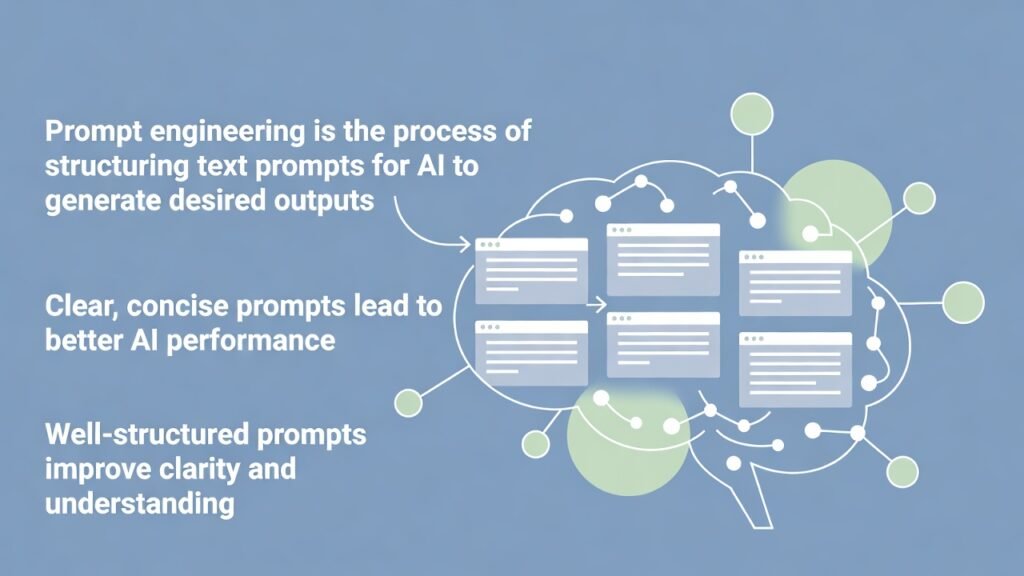
Prompt engineering is the practice of carefully designing the instructions—the prompts—you give to an AI tool to get the best, most reliable response. It’s not about complex code; it’s about clear, structured communication.
Consider these two approaches to giving an AI a task:
- Ineffective Prompt: “Write about social media.”
- Engineered Prompt: “Act as a social media manager for a boutique fitness studio. Write three Instagram captions for a new yoga class launch. The audience is women ages 25-45. Tone should be encouraging and uplifting. Include one relevant hashtag and a call-to-action to book a spot. Keep each caption under 150 words.”
The first prompt is vague, leaving the AI to guess your needs. The second provides context, role, audience, format, and tone. This structured input is prompt engineering. It transforms AI from a random generator into a focused co-pilot, directly improving your AI output quality.
Why Your AI Gives Inconsistent Output (And How to Fix It)
Why does an AI give a great answer one minute and a terrible one the next? This inconsistency is the top user complaint. Understanding the cause is the first step to a solution.
- AI Reflects Your Input: Generative AI creates text based on patterns. A broad prompt like “marketing tips” pulls from millions of generic sources, yielding obvious, low-value content.
- The Context Gap: The AI doesn’t know your business, audience, or goals unless you specify them. Without this data, it defaults to average, generic outputs.
- Subjectivity Causes Confusion: Words like “better,” “engaging,” or “professional” mean different things to different people. The AI needs concrete definitions.
- Missing Guardrails: Without constraints, AI can hallucinate (make up facts), go off-topic, or produce inconsistent formats.
The core principle is Garbage In, Garbage Out (GIGO). A low-quality prompt guarantees a low-quality, inconsistent output. Mastering prompt engineering breaks this cycle.

5 Common Prompt Mistakes That Ruin AI Output Quality
Are you making these errors? Most beginners do.
- The Overly Brief Prompt: “Blog intro.” (Too little information.)
- The Vague Request: “Make it sound good.” (No clear direction.)
- The Information Dump: A long, confusing paragraph with multiple hidden requests.
- The Missing Frame of Reference: “Expand on the last point.” (The AI often lacks conversation memory without context.)
- Ignoring Format & Audience: Not specifying if you need bullets, a table, or a formal tone for executives.
Recognizing these mistakes is your first step toward writing effective AI prompts.
https://platform.openai.com/docs/guides/prompt-engineering
How Prompt Engineering Creates Consistent AI Results
Prompt engineering solves inconsistency by adding clarity and structure. It works by:
- Assigning a Role: “Act as a seasoned SEO specialist…”
- Defining the Exact Task: “Write a 300-word meta description for a page about vegan protein powder.”
- Setting Specific Guardrails: “Use a friendly tone, include the primary keyword ‘plant-based protein,’ and end with a question.”
- Providing Examples (Few-Shot Prompting): Showing the AI 1-2 samples of your desired style.
- Using Step-by-Step Logic: Breaking complex tasks into sequenced instructions for better reasoning.
This method removes guesswork, leading directly to consistent and reliable AI results.
5 Essential Types of AI Prompts for Beginners
Start using these prompt structures today.
1. Basic Instruction Prompts
Simple, direct commands.
- Example: “Summarize the following article in four bullet points.”
2. Role-Based Prompts (Highly Effective)
Assign an identity to shape the AI’s expertise and tone.
- Example: “You are a friendly financial planner explaining budgeting to college students in India. Use simple analogies and avoid complex terms.”
3. Step-by-Step (Chain-of-Thought) Prompts
Guide the AI’s reasoning for complex tasks.
- Example: “Let’s brainstorm email subject lines. Step 1: Identify the core benefit of my product (saves time). Step 2: List three emotions tied to that benefit (relief, control, freedom). Step 3: Write five subject lines combining the benefit and one emotion.”
4. Constrained Prompts
Set limits to boost creativity and relevance.
- Example: “Write a product description for this bamboo toothbrush in under 120 words. Use active voice. Do not use the word ‘eco-friendly.’ Include one bulleted list.”
5. Template & Format Prompts
Specify the exact structure you need.
- Example: “Fill this template: Headline: [Create a curiosity gap]. Problem: [State the reader’s pain point]. Solution: [Introduce my product as the fix]. CTA: [Use a strong action verb].”
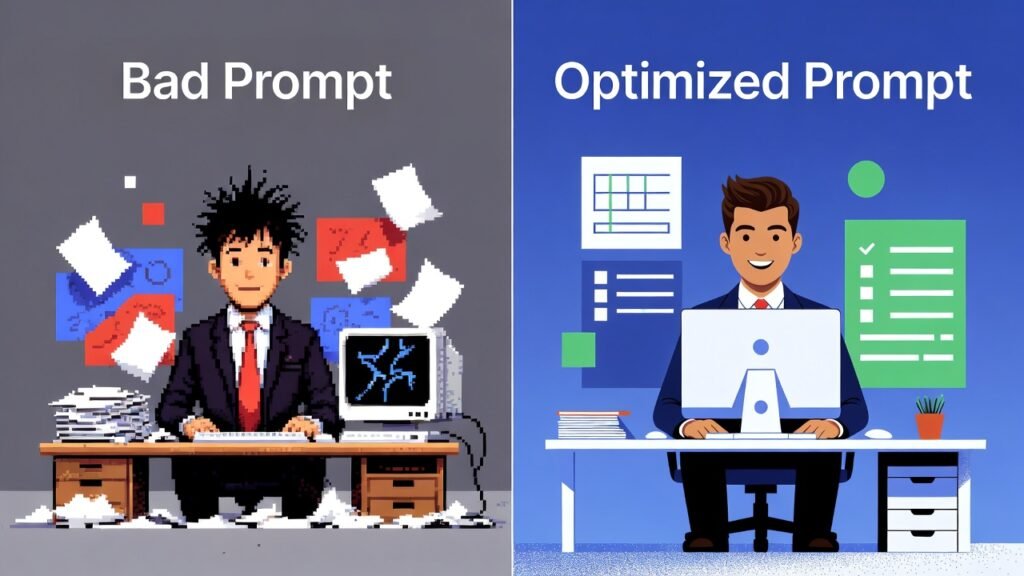
Real-World Examples: Bad Prompt vs. Optimized Prompt
See the transformative power of prompt engineering in action.
Scenario 1: A Blogger Needs Topic Ideas
- Bad Prompt: “Give me blog ideas for my website.”
- Optimized Prompt: “You are a top-ranked food blogger. Generate 8 blog title ideas for an audience of busy parents in the USA interested in quick, healthy dinners. Titles must be under 60 characters, include a number, and focus on ‘30-minute’ recipes.”
Scenario 2: A Freelancer Writes a Client Email
- Bad Prompt: “Write a follow-up email.”
- Optimized Prompt: “As a freelance web developer, write a concise (under 100 words), polite follow-up email to client ‘DesignCo.’ Reference the proposal sent on April 10th for website redesign. Reiterate your enthusiasm, ask if they have questions, and suggest a brief call next week. Avoid sounding pushy.”
Scenario 3: A Marketer Creates Ad Copy
- Bad Prompt: “Ad for my accounting software.”
- Optimized Prompt: “Write 4 variants of a Google Ads headline (30 chars max) and description (90 chars max) for ‘SimpleLedger’ cloud accounting software. Target small business owners. Keywords: ‘easy invoicing’ and ‘tax tracking.’ Highlight: automated reports and no contract. Use a benefit-driven, trustworthy tone.”
Your Step-by-Step Prompt Engineering Framework: CREATE
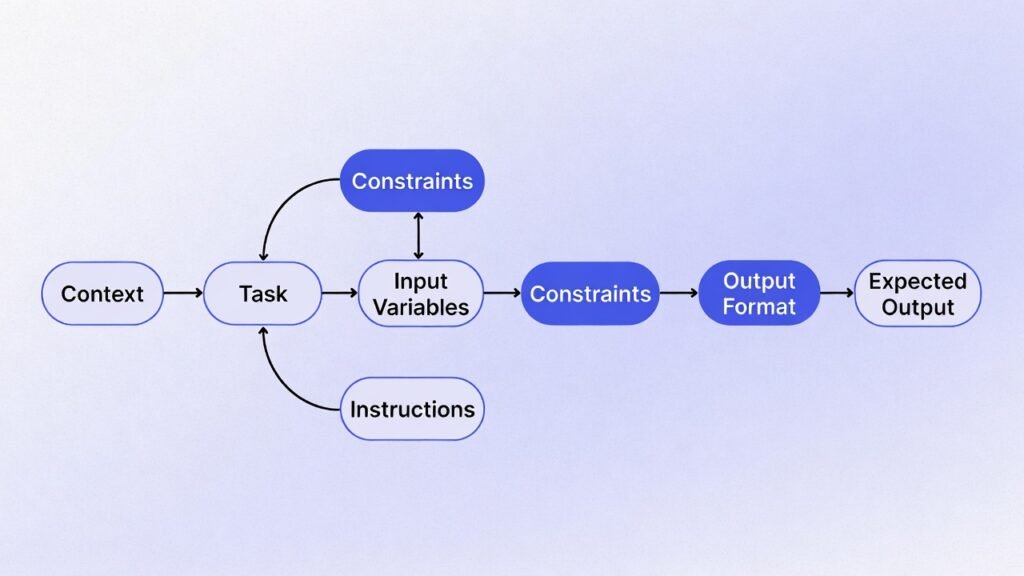
Use this repeatable “CREATE” framework for any task to ensure consistent AI results.
- C – Context & Role: Who is the AI? (e.g., “You are an expert career coach…”)
- R – Request (Core Task): What must it do? Be specific. (e.g., “Draft a cover letter for a project manager role…”)
- E – Examples & Format: What should it look like? *(e.g., “Use a professional tone, structure with 3 paragraphs, and output in a ready-to-copy text block.”)*
- A – Audience & Tone: Who is this for, and what’s the voice? (e.g., “For hiring managers at tech startups, use a confident and innovative tone.”)
- T – Technical Details & Limits: Set the guardrails. (e.g., “Keep it to 250 words. Exclude generic phrases like ‘team player.’ Do not use markdown.”)
- E – Evaluate & Refine: Run the prompt. Review. Tweak. Ask, “Revise the previous output to be more data-driven.”
Who Benefits from Prompt Engineering? Real Use Cases
- Bloggers & Content Creators: Generate outlines, meta descriptions, title variants, and repurpose long articles into Twitter threads or newsletters.
- Freelancers & Solopreneurs: Draft project proposals, create service agreements, generate social media content calendars, and write client onboarding emails.
- Digital Marketers: Write PPC ad copy variations, develop email nurture sequences, create A/B testing ideas for landing pages, and analyze customer reviews.
- Students & Researchers: Summarize academic papers, create study guides, practice interview questions, and explain complex concepts in simple terms.
- Small Businesses: Develop standard operating procedures (SOPs), create FAQ sections, draft company policies, and generate product description batches.
Best Practices for Writing High-Quality AI Prompts
- Iterate, Don’t Expect Perfection on First Try: Start with a solid prompt, then refine: “Now, make the language more conversational.”
- Use Keywords and Quotes Strategically: Place critical terms in quotes. Integrate related LSI keywords naturally (e.g., for “prompt engineering,” use terms like “AI guidance,” “input design,” “query structuring”).
- Prioritize Clarity Over Cleverness: Be direct and unambiguous. The AI isn’t judging your poetry.
- Leverage “Few-Shot” Learning: Provide examples. “Example 1: [Your sample]. Now, create a new one following this style.”
- Command with Action Verbs: Start with verbs: “Write,” “List,” “Compare,” “Translate,” “Rewrite,” “Format this data as a table.”
The Future of Prompt Engineering & AI Skills (2026 and Beyond)
By 2026, basic prompt engineering will be a standard digital skill, like using a spreadsheet or a search engine. Expect:
- Specialized Prompt Roles: Careers like “Prompt Optimizer” for industries like healthcare or legal.
- Seamless Software Integration: AI prompting built directly into your email, design, and analytics tools.
- Multimodal Prompting: Engineering prompts that blend text, image, and video generation seamlessly.
- Focus on Verification & Fact-Checking: Advanced prompts that instruct AI to cite sources and flag uncertain information.
The ability to precisely guide AI will separate those who are frustrated from those who 10x their productivity and creativity.
Conclusion & Key Takeaways: Master Your AI Output
Struggling with inconsistent AI is a solvable problem. The solution is upgrading your own communication skills through prompt engineering. This is the bridge between your intent and the machine’s execution.
Your Action Plan:
- Be Specific: Clearly define the task, role, and audience.
- Set Constraints: Use word counts, tone instructions, and exclusions to focus the AI.
- Embrace Iteration: Your first prompt is a draft. Refine based on the output.
- Use the CREATE Framework: Context, Request, Examples, Audience, Technicals, Evaluate.
By applying these principles, you transform AI from a frustrating novelty into a consistent, powerful partner. You’ll save hours, improve content quality, and unlock creative potential you didn’t know you had.
What is prompt engineering in simple terms?
Prompt engineering is the skill of writing clear, detailed instructions for AI tools to get the best and most consistent results. It’s like learning the most effective way to talk to a brilliant but very literal assistant.
How can I improve my AI output quality immediately?
Start by adding more context. Always specify: 1) Who the AI should be (a role), 2) What you want (the exact task), and 3) Who the output is for (the audience). This simple triad dramatically improves results.
Are there free resources to learn prompt engineering?
Yes. Many AI tool providers offer free guides and prompt libraries. The best practice is to experiment using frameworks like the “CREATE” method outlined in this article and analyze what works for your specific needs.
: Do I need to be technical to write good AI prompts?
Not at all. Effective prompt engineering relies more on clear thinking and concise communication than technical knowledge. It’s a skill for writers, marketers, students, and business owners.
Can prompt engineering help with AI writing for different regions like the USA and India?
Absolutely. You can engineer prompts to include regional context. For example, specify “for an audience in India” and mention local currencies (₹), festivals, or cultural references to make content highly relevant.
Ready to command your AI with confidence? Stop struggling with random outputs. Take one task you’ll do this week and apply the CREATE framework. With practice, you’ll develop your own library of powerful prompts that deliver exactly what you need, every single time. Start your journey to consistent AI results today.
Next Blog: From Prompt to Perfect: How to Structure Long-Form Content with AI(Publish Tomorrow)
Save on Hosting: Use Our Exclusive Hostinger Discount Code
https://hostinger.in?REFERRALCODE=CM8MK7508CRS
RELATED POSTS
View all


AI Tools for Solopreneurs: Work Less, Earn More in 2026
January 4, 2026 | by mk75089317@gmail.com

Upwork Freelancing Kaise Start Kare India Se – Complete Beginner Guide (2026)
January 31, 2026 | by mk75089317@gmail.com

How to Create & Sell AI-Generated Digital Products in 2026 (Beginner’s Guide)
January 20, 2026 | by mk75089317@gmail.com